
Welcome to JP ALT’s introduction to Japanese new wave. New wave, or “new music” emerged in the late 70s and found prominence in the early 80s. While its roots are heavily tied to the new romantic movement which overwhelmed the UK in the 80s, Japanese new wave is often forgotten in the new wave history books, despite pioneering some of the most experimental renditions of the genre.
JP ALT has compiled the essentials of Japanese new wave: deconstructing the genre into its sub sects (synth-pop, avant-garde and post-punk) to create a comprehensive guide to understanding Japanese new wave.
Synth pop/ Electronic
Solid State Survivor– Yellow Magic Orchestra

The legendary Yellow Magic Orchestra, comprising of Yukihiro Takahashi, Haruomi Hosono and Ryuichi Sakamoto is without a doubt one of the most important bands in Japan’s history. They entered the scene just in time for the new wave boom and quickly became the leading force of the genre. Their 1979 Solid State Survivor exemplifies what the genre in Japan stood for, namely experimentation and pop playfulness existing in perfect harmony. The album, despite synth-heavy and mechanical, is a warm record evoking vivid imagery of a perfect technological progress. The robotic vocals, repetitive synth riffs and precise angularity is new wave at its finest. Solid State Survivor boosted the members of YMO to even bigger stardom and solidified their status as legends, and tracks like ‘Rydeen’ and ‘Behind The Mask’ quickly became iconic.
The songs on Solid State Survivor are perfectly cerebral despite their quirks. Yellow Magic Orchestra also turn the rather cold new wave movement into something uplifting and futuristic, due to the album’s strikingly bright melodies. Just listen to ‘Rydeen’, this track makes you feel like you’re flying above a futuristic version of Tokyo without a care in the world. The experimental and bold edge is still present in the album, however everything is wrapped in infectious pop melodies which stole the hearts of so many people, even Michael Jackson, who sampled and covered “Behind The Mask”.
In A Model Room– P-MODEL

P-Model entered the scene at the same time as Yellow Magic Orchestra. Susumu Hirasawa, previously the frontman of progressive rock Mandrake, had grown tired of the genre and was looking for something fresh to reinvent his career. After seeing how new wave has been developing in the West and working with various kinds of synthesizers, Hirasawa and his band mates decided to rebrand as P-Model, a new wave/synth punk band. Their debut album, In A Model Room, came 8 months after the band began its activities. In A Model Room consists of 11 tracks with an average runtime of 3 minutes each, every single one built around a catchy chorus and verses supported by biting synthesizers. The instruments interlock in a jagged manner, underlining the dystopian topic matter of the album. Some tracks are almost spiky in their sound. The synths are cold and at times chaotic, at times painfully precise. In A Model Room is a claustrophobic album, and its form reflects anxiety born the fear of being watched and controlled by the systems. Susumu Hirasawa’s vocals aren’t pretty on this record, most of the time they’re either screamed or anxiously spoken. In A Model Room is a staple record in new wave nonconformism.
Neu- Polysics

Presentation was a really important thing for new wave acts. YMO in their red suits, P-Model with bright colors and nonsensical phrases, and Polysics, who sported orange boiler suits and straight bar sunglasses. Polysics fuse synth punk with new wave on Neu, a sound that really fits their stage presence. The songs on Neu are fast, with Hayashi’s screaming vocals on top of punk beats infused with electronic sound effects. What is apparent with these new wave records is that they’re seemingly chaotic, but in reality, all rhythms are meticulously crafted, nearly arithmetic in their sound. This is true with Neu as well, an album that pays homage with its title to the legendary German band Neu!. Polysics started their activity 20 years after the debuts of YMO and P-Model, apparent in the band’s futuristic early 2000s sound, a staple of the era.
Après-Midi — Testpattern

Is it professional to label an album as “adorable”? Is it wrong to be honest and say the opening track is so cute it makes me want to cry? Produced by Haruomi Hosono, cult-classic (and wildly expensive to buy), Après-Midi is low-fi compared to the other great synth releases of the early 80s, but intentionally so. Don’t expect to be transported to some other dimension with this album, it insists on its simplicity. But it’s in that simplicity, found especially in the straightforwardness of the lyrics, that makes Après-Midi an uncomplicated and pleasant listen. Seriously, look at these lyrics:
Tell me your name / You are my sunshine girl / Your blue eyes take my breath away / You are my sunshine girl / Wanna hold you close to me / You are my sunshine girl/ I love you so.
Bamboo Houses / Bamboo Music —David Sylvian and Ryuichi Sakamoto:

While most new wave bands in the UK were following the loose definition of a “re-imaging of punk”, Japan, lead by David Sylvian, had become a fronteering presence in mixing the coldness of synth-pop and dramatics of new romantic elements together. This unique combination would catch the eye of Ryuichi Sakamoto of Yellow Magic Orchestra, who would collaborate on Japan’s track ‘Taking Islands In Africa’.
Sakamoto and Sylvian would collaborate on a range of projects, most famously the track ‘Forbidden Colours’, written in response to Sakamoto’s film debut in Merry Christmas Mr Lawrence. However, their two track single Bamboo Houses / Bamboo Music is a significant snippet of the most ‘new-wavey’ elements of both artists’ respective eras. ‘Bamboo music’ hosts a wobbling synth throughout its chorus that could only be described as ‘completely sanitised’. Contrasted with Steve Jansen’s full, but sharply played drum machine and Sylvian’s catchy chorus, Sakamoto’s synth contributions helped to create an atmospheric and tightly rounded piece. The track ‘Bamboo Houses’ found its way onto Virgin’s Post Punk & New Wave ‘76-’83 compilation; Sakamoto becoming the only Japanese artist to feature in the series of post-punk compilations in the West.
It’s hard to believe this particular collaboration only survived a couple of tracks. Yukihiro Takahashi and Japan drummer Steve Jansen would go onto collaborate together with the track ‘Stay Close’, which was ultimately a short lived project as well.
Masami Tsuchiya – Rice Music

Masami Tsuchiya is most recognised in Japan for his participation in Ippu-do, a new wave synth-pop band that falls heavier on the ‘pop’ element than most of the bands listed here. However, in the West, Tsuchiya’s career is mainly attributed to his contributions to the band Japan and relationship with Yellow Magic Orchestra. This leads us to his solo album Rice Music, filled to the brim with collaborations between Japan band members Steve Jansen (drums), the late Mick Karn (fretless bass) and Ryuichi Sakamoto. Like the other Japan-YMO-incorporated projects, cool, sanitised synths ring through the tracks.
However, by sifting through the standard formulaic elements of the Japan-YMO-incorporated universe, Tsuchiya has twisted them ever so slightly to create a poppier and more eccentric experience. Tangoing alongside recurring backing vocals that feel like an additional character to this project, saxophones, loose, fretless bass solos from Karn, lyrics about China, rice and China again— overall, it feels like an unconventional, janky album you’re supposed to enjoy instead of think deeply about, unlike the sophisti-pop (literally, ‘sophisticated pop’) elements seen in the collaborations between his peers.
Welcome Plastics– Plastics

Plastics debuted in early 1980s, and their guitarist Masahide Sakuma produced P-Model’s In A Model Room. The band stands for modern artificiality, with their name itself evoking an image of a cheap plastic craft. The rhythms of Welcome Plastics are dry and stripped of warmth, similarly to P-Model’s debut, they work on repetition and groove built around a catchy chorus. The tracks are short and they get stuck in your head easily.
The instruments on Welcome Plastics create a layered texture of the aforementioned artificiality, and the music itself is treated as a part of a wide cultural zeitgeist of Japan in the 80s. Plastics have deep ties to Japan’s fashion scene, they put emphasis on the presentation and treat it as a primary component of the band’s identity, something that new wave bands of the time were really good at. The band embraces plastic as their own identity, a surface-level quick product. The modern power systems are embraced on Welcome Plastics, happy tunes speaking about commercial copies or cosmopolitanism are vastly found on the record. This stands in contrast to P-Model that tries to break away from the said system, and while Plastics still ironize the status quo, it is much more subtle and hidden between the lines than with Hirasawa’s band.
の近代体操- Halmens

This 1980 album is full of abrupt mood and tempo shifts propelled by a wide array of instrumentation and Kenzo Saeki’s passionate vocal performance. The songs can get airy at times, an example being the opening 昆虫群 (Insects), a track built around a pulsating rhythm existing over a lush synthesizer backdrop. It’s a gentle track despite the genre’s craziness. The album’s trackflow is an unstable one. The tracks are sometimes cute and groovy, sometimes alien or hysterical. The staple new wave nervousness permeates the record, infusing it with a sense of fractured identity translated into a soundtrack. The title, Modern Gymnastics, is a fitting one for the record, it could very well be a soundtrack to a gym class for robots in a far future. The movements are chimeric, and however, predictable, they’re still wild and unexpected. の近代体操 is a perfect example of the Japanese 1980s synth-driven mania.
Avant-garde
ヤプーズ計画 – Yapoos

Yapoos was a new wave band led by the legendary Jun Togawa. Their 1987 debut album, ヤプーズ計画 develops the early notions of new wave and fuses it with some good old techno kayō. As the usual case with Jun, her vocal performance on the album is wild, ranging from hysterical highs to solemn, commanding lows. The album’s subject matters are a wide array of dystopian topic: society ruled by robots who control humanity with sex, love being compared to dismemberment and cannibalism, girls being cybernetically modified in order to not lose their virginity… the list goes on. Togawa is a master of creating these kind of worlds in their songs and walking the talk with her vocals, which can be quite unsettling at times. ヤプーズ計画 develop the ideas of control and surveillance tackled in many new wave records and extend them to concern the human body, instead of society at large or technological measures. The body in the world created by Yapoos on this record is a site of control, which can be taken over by a parasite in power and used for control, with for example, sexuality which is used as a tool of coercion. The irony and sarcasm so prevalent in new wave is totally abandoned here. Yapoos’ status as a household new wave name was solidified in 1989, when Susumu Hirasawa of P-Model joined them as a support act, frequently collaborated with Togawa, and even provided a few songs for their 1992 Dadada ism.
好き好き大好き – Jun Togawa

This is the part where new wave gets really contradictory. In her solo projects, Jun Togawa pairs innocence and cruelty, sarcasm and sincerity, order and chaos. While intense as well, her work with Yapoos is more on the industrial side, and 好き好き大好き clothes the cold new wave synthesizers and uncomfortable subject matter in pop-perfect melodies. One of the most ‘manic’ albums ever recorded, Togawa’s emotions are pouring through each track- something that makes much sense with Togawa’s acting background. She is a master at creating a character so removed from societal standards, so absurd, that it feels simply off. Unsettling. Her high-pitched, childlike voice can change into one of a vengeful spirit in the same sentence. This makes the disturbing lyrical content hit even harder.
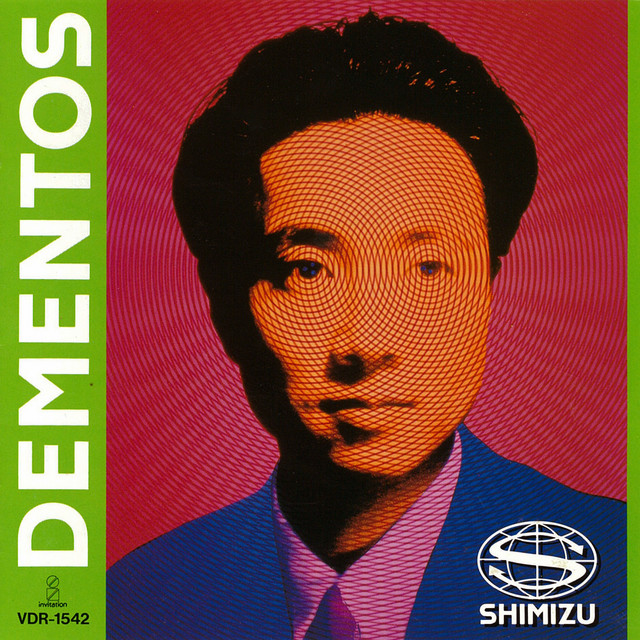
DEMENTOS — Yasuaki Shimizu

Despite its 1988 release date, Dementos is arguably Yasuaki Shimizu’s most new wave adjacent album in his discography. Shimizu collaborated with Tears for Fears drummer Manny Elias for this project, as well as percussionist Pandit Dinesh who worked with Heaven 17, a UK synth-pop trio. These collaboration choices certainly support the contention that Shimizu intended on a stint into his version of new wave.
Curiously, this release has an almost ironically commercial or tacky sound amongst hyperpolished and carefully curated synths, which often falls into thunderous and triumphant whirlpools recalling elements of pop. What makes this release especially interesting is Shimizu’s interest in world music, most evident on the tracks ‘Find No Words to Say’ and ‘I’m Dying For Love’. Shimizu’s blend of his personal music interests layered onto this re-imagining of commercial wave music makes Dementos an entirely unique rendition of the new wave genre—an experience only Shimizu himself could pull off.
Post-punk
Meshi Kuuna! — Inu

Inu was a short-lived project of an actor/poet Kō Machida, producing only one album in 1981 and disbanding three months after its release. Despite its short lifetime, Inu’s Meshi Kuuna! became one of the most influential albums in Japanese music. It’s new wave fused with post punk at its finest, the album is raw and unpolished, Machida’s vocals are frantic and all over the place, the tempos are chaotic and can change multiple times in one track, the guitars are unhinged and distorted. Machida’s performance foreshadows his lyrical genius, which later would get him many accolades for his poetry. Meshi Kuuna! carefully examines the absurdities of daily life, the lyrics are grotesque and spat in your face, and the album’s title literally means “don’t eat food!”. Inu are the leading voice of the underground resistance of the 80s, utterly rejecting the notions being pushed by the powers that be. The album is also one of the most important works of the Kansai No Wave subgenre, which existed in the Kansai region with most prominence in the first half of 1980s. Other important bands of this movement include Jagatara and Hijokaidan.
Aburadako [木盤] — Aburadako

Aburadako (1983-2008) gained cult status for releasing a series of albums with the same names, (literally Aburadako – Aburadako, everytime), a distinctive noise-rock sound that became popular in the hardcore scene and complete noncompliance with ‘verse-chrous-verse’ politics. Changing band members, avant-garde when they feel like it, album covers only recognisable by “Oh, the one with the tree on it, okay.”, a disregard for time signatures— Aburadako has one of the most bizarre discographies in Japanese music. Oftentimes, when listening to Aburadko you may find yourself feeling like you’re watching a grown man have a crisis, and it’s probably best you don’t get too close. Is it random or genius? JP ALT leans towards the latter.
Aburadako’s first full length album is widely regarded as a Japanese post-punk classic, although it’s easy to get the sense that they didn’t intend to be labelled as post-punk at all. Their most streamed track ‘P A R A N O I A’, which is deceivingly well behaved, mirrors late atmospheric 70s post-punk from the UK very closely. Notably similar to the tracks ‘Somewhere’ by the Danse Society, or the same bittersweetness and defeatedness you’d see in other UK post-punk tracks such as ‘Silent Scream’ by Ski Patrol.
Dream of Embryo / Double Plantonic Suicide — Funeral Party

Short lived and with minimal releases, there isn’t much known about Funeral Party. Although this EP falls under the darkwave genre, new wave and post-punk music are widely considered the precursors of darkwave. Much like how post-punk inspired the goth movements and even early Buck Tick tracks (as discussed above), Funeral Party’s Dream of Embryo / Double Platonic Sucide has gained cult status online in recent years for its atmosphere of dread and striking visuals.
With this EP’s design illustrated by eroguro artist Suehiro Maruo, the visuals enough may prepare you for the overall tone of the piece, but not the wave of lethargic heaviness that’s thrown in the listeners direction in the first 10 seconds of the opening track.
Aunt Sally — Aunt Sally

Formed in 1978 in Osaka, Aunt Sally was short-lived, only releasing Aunt Sally in 1979. Despite this, Aunt Sally is one of the most recognisable post-punk releases to come out of Japan. Fronted by Phew, who carries a long career in the avant-garde/ experimental scene and has also collaborated with the likes of DAF and Einstürzende Neubauten, Aunt Sally offers a complete deconstruction of 70s punk. Stringy guitars reminiscent of freeform no wave predecessors, reimagined nursery rhymes, ironically jovial at times with an ultimately minimalistic form of chaos underlying the album, Aunt Sally is a timeless and essential capsule of the beginnings of post-punk in Japan.
Kurutta Taiyo —Buck-Tick

Buck-Tick’s 1991 release, Kurutta Taiyo (Crazy Sun) was a pivotal moment for the legendary visual kei band. Every member has stated that this is the album that was a true turning point for their artistic identity. It’s a record with a turbulent and tragic backstory, as it was inspired by Atsushi Sakurai’s mother’s death. This event propelled Sakurai to start expressing himself more truly. This can be noticed with the lyrics, and as Sakurai later stated, Kurutta Taiyo was the first time he’s felt he expressed himself freely after departing from using ornate words to evoke a sense of grandiosity. The vocal direction changed as well, as Sakurai started to put emphasis on how his vocals sounded post-production, something he has been leaving to chance before. This resulted in more vocal texturing over straightforward delivery, mirroring the new wave tendency of using vocals as an instrument, and not as merely lyrical explanation. The previous Buck-Tick albums were primarily new wave as well, but they put an emphasis on theatrics and the band didn’t have a clear artistic direction yet.
The sense of urgency and apathy comes from Sakurai’s emotional state after his mother’s passing. He described the period after receiving the news as one big blur, stating that he forgot about everything that happened on the tour prior. The album’s title is also a tribute to his mother, who Sakurai compares to the sun’s overwhelmingly warm presence. The album’s musical side is a clear evolution of Buck-Tick’s sound, incorporating more electronic elements and uncommon time signatures. The album was created for a deadline which was nearly not met, mirroring the new wave tendency of hyperproductivity with multiple rehearsals and an intense recording process full of pressure.
Honorable mentions:
Nanban Torai — Jagatara: 1979, reggae, upbeat
Tadaima — Akiko Yano: 1981, new wave, electronic, new wave classic
Paradise of Replica —After Dinner: 1989, avant-garde, whimsical
Spacetime Patrol — PEVO: 2015, so, like, imagine if P-model met Devo
HOYO — Noizunzuri: 1985: post-punk meets traditional Japanese folk music
Read our interview with Noizunzuri guitarist Mitsuru Tabata here


Leave a Reply