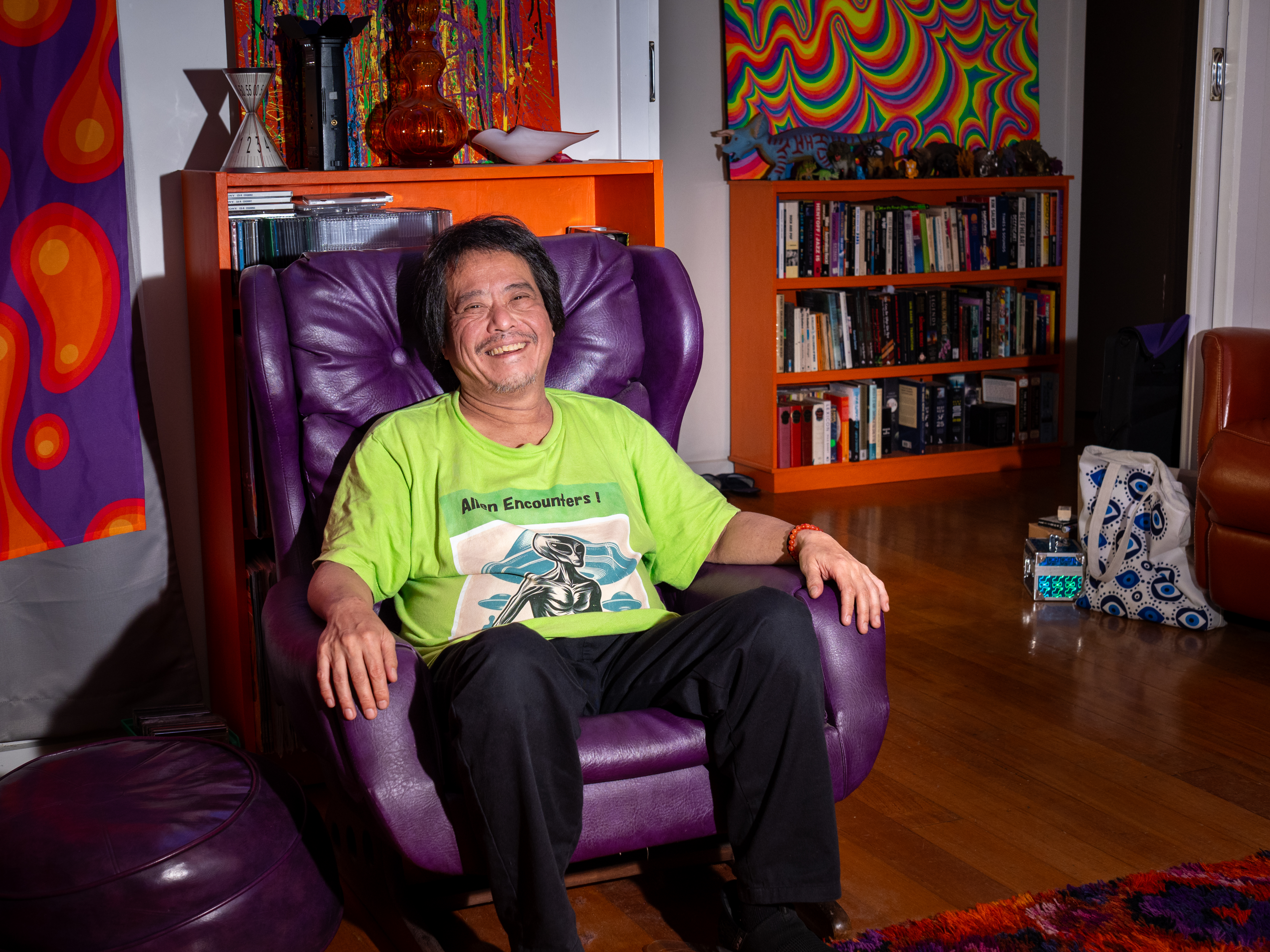
Photos by Alex Zucco
From Boredoms to Acid Mother’s Temple, Mitsuru Tabata has an impressive and influential decades-long career of solo, band and collaborative projects, working alongside notable and renowned figures in Japanese and English music.
Combining traditional Japanese folk-music and early post-punk in Noizunzuri, post-hardcore noise rock in his 20 years with Zeni Geva, to his roaring psychedelic rock escapades in Acid Mother’s Temple, Tabata’s legacy could be felt within seconds of hitting record for the interview.
A pioneer of avant-garde and overall chaos, Tabata spoke to JP ALT about the highlights (so-far) of his career at Paul Kidney’s psychedelic mansion in Melbourne, following the end of his Victorian stint of the Paul Kidney Japanese Experience tour. Before I had the chance to ask my first question, Tabata quickly interjected:
“Tabata’s family tree: Jirobe Tabata. Date of birth unknown. April 7, 1842— died. That was the first Tabata, I’m the 6th generation of Tabata. If I don’t have a child, the Tabata family is gone.”
“So, you’re the last Tabata, the final Tabata?” I asked.

The Interview
Yes, the final Tabata!
I was a child in the 1970s. That time in Kyoto was really weird for me. I went to a Christian kindergarten. My grandfather’s funeral was completely Buddhist style. Then I’d go home and put on the TV: Ultraman! He was destroying the whole city! I thought, what the fuck? What the fuck is going on in my world?
Before I listened to rock n’ roll or bands, it was coincidentally my Aunt who had a Rolling Stones single at home. But before that, the sound effects from sci-fi monster movies (Tokusatsu) were a huge influence to me: ‘PI! PI! PI! PI! PI! Ahhh, Godzilla’s roaring… raaaaahhhhh!’
As a teenager, I’d go to this venue near my house. I remember seeing the band SS— they were basically the first punk-rock band in Kyoto. Do you know the band called Buddhadata? The drummer in that band, he’s my high school elder.
Was there a specific record you heard growing up where you thought, ‘Oh, my God, I have to play music now?’
When I was six years old, I listened to Led Zeppelin’s second album. But, I wasn’t influenced by the hard-rock section. The psychedelic bongos, the soundscape, I was mostly inspired by that.
[Tabata was in a high school band named Sanagi, inspired by The Slits and other new wave and post-punk influences.]
Some major company was going to release the first Japanese reggae band compilation. We sent a practice tape to the label, and they said “Oh, can you be in Tokyo to record it?” But I had exams, so I couldn’t make it— I was like don! But we were able to go later on.
Can you still listen to it? Is it on the internet anywhere?
I think so, but I don’t know. It was called Jap Reggae or something. Japan Reggae Clash?

Noizunzuri, Eye and Hanatarash
Before I moved to Tokyo, I joined a band called Noizunzuri. It sounded a bit like Public Image Ltd; a post-punk band, right to traditional Japanese music. I continued with Noizunzuri in Kyoto. At the time, I worked as a security guard at a venue in Kyoto, but I was a small kid doing the ‘security guy’ thing at the door. Someone was diving off the stage, that was Eye Yamantaka (laughs).
We had the same friend, so they introduced me to Eye Yamantaka. The next day he just showed up to my apartment. He’s going to live in my apartment.
Tabata worked along artist Jun Togawa on Noizunzuri, a post-punk folk inspired band clashing punkish elements with traditional Japanese folk music.
I have a question about that, actually. So on the internet, in English, it says you were a member of Hanatarash.
Actually, yeah, that information has been wrong for a long time… I was just helping them. They were like, ‘Heya! Let’s make a time bomb! Let’s test out the time bomb on a river or something! Let’s create a really, really serious explosion!’ Something like that, not like typical rock n’ roll.
Hanatarash had a show opening for Psychic TV. I was working in Kyoto at the time so I couldn’t go. They were all “Oh, we’ll do another time bomb! Let’s destroy the concert and kill every psychic-tv fan!’ The organisers found the bombs under the stages. They boarded Hanatarash in the dressing rooms. They couldn’t escape, and the show was over. Only Hanatarash’s show was cancelled, and Psychic TV played safely. Every music venue refused Hanatarash after that.

After that, Eye Yamantaka said he wanted to play in some real bands— musical bands. “Oh, I already destroyed the band. Everybody’s scared of me!” he’d say. He wanted to be more poppy, a girl’s band. So, I took the band name from Buzzcocks, a track called ‘Boredoms’.
Okay, well, maybe next we’ll play like Buzzcocks with poppy, emotional punk-rock, like Toy Dolls. Then we started to practice, and that became Boredoms.
You left Boredoms after one track, do you regret it?
It was a big joke. Like my biggest mistake. All those years ago, some people didn’t like to do the whole two-band thing, especially band leaders. I had to pick Boredoms or Noizunzuri. After me, Seiichi joined Boredoms, and then Yoshimi. Boredoms suddenly got better (laughs). Well, when I was there, they were shitty. Really shitty.
The beginnings of Boredoms, and Tabata’s tracks.
What pushed you to pursue a more experimental direction?
When I played in Sanagi, my high school band, we were getting a lot of traction. One of our shows was a full house. After the concert, a very scary looking uncle came up to me and asked to play the drums. He was a free jazz drummer called Shoji Hano. That was the first time I saw free jazz drumming, I still play with him.
So I saw the Incapacitants show— they were Mikawa and Kosakai from Hijokaidan. Mikawa and Eye Yamatsuka were the original Incapacitants before Kosakai joined. Then I saw it was happening everywhere. Yeah, you sometimes play with the punk rock band, sometimes play with the reggae band, yeah? Not so many people in the music scene, genres, nothing, everyone played together.
Past band members are kind of like music teachers to me. They taught me so much about noise and serial killers. Actually, Eye Yamatsuka taught me about the zodiac killer. KK Null was an influential music teacher to me, he was very knowledgeable about electronic music composition.
Zeni Geva and Steve Albini
So, Zeni Geva?
After Boredoms and Noizunsuri broke up, I moved to Tokyo and started Zeni Geva. It was around the disaster days. You know, America was going to bomb Iraq.
At the time Zeni Geva was a super unknown band in Tokyo. And suddenly, the KKNU had the experience of a solo America tour. Yeah, Zeni Geva was getting pretty famous in America. We were like, okay, we’ve got to go to America. But we had no money (laughs). But, you know, I put in a lot of hard work to get the money. Then some American guy introduced us to Steve Albini.
What was it like working with Steve Albini?
He didn’t have an electrical studio back then.. He was recording in his basement. It was a really, really distant, dark downstairs basement. The console room was the kitchen.
Steve Albini, he didn’t ever want to play Big Black or Rape Man songs. But we did cover Big Black’s ‘The Model’.
He stated, it’s not like he’s doing a huge tour for an overseas, famous band when he’s in Japan. He just came to like it here. Like, daily life. Enjoying daily Japanese life. Everyday he was recording Japanese bands in his studio in Tokyo. It was pretty exciting.
How did you feel about Steve’s passing?
I was staying in my mom’s house in Kyoto. I was like what the fuck? I don’t know. It’s just so… it happened a little too suddenly.
Zeni Geva and touring
In the 90s, tours were really organised. Probably because lots of American bands were playing in Europe at the time. It was the grand explosion days of touring, and our booking agent was in the Netherlands. There were five of us, including two American girls. They were basically hippies (laughs). One of them was a tour driver and the other was a merchandise girl.
We were going to France, trying to get across the border. The English organiser didn’t have work permits for the girls and they had to pretend to be tourists. It was them and three Japanese guys waiting at the ferry past the border when the police suddenly arrived. They brought out the sniffer dogs, dogs screaming everywhere! I remembered the tour driver did the same job for Green Day, the smell was everywhere (laughs). We missed the ferry.
On another tour, our van was stolen in a parking lot in Warsaw. It would’ve been 1996 in Poland or something.
It’s always happening in Poland.
It seemed like people were happy to see it— like,“Wow, a Japanese van!!! The first we’ve seen in Poland!!!” We were happy and we forgot the locks, like… I don’t know. It’s okay. Looks safe. We’ll keep everything in the van because it’s the hotel’s parking lot. Nothing happened.
“Tomorrow’s our day off, let’s go tomorrow, let’s go see Auschwitz. Let’s go tomorrow!”
We woke up the next morning and there was no van there. Someone stole it. We called the police. They took everything. I had dirty clothes and a passport.
Two uniformed policemen and one detective arrived. He was wearing a leather jacket and jeans. And a baseball cap, it said ‘chronic’. And the picture on the top, you know, a leaf of marijuana. On his baseball cap. I’m like, what?
“Are you guys from the Japan? Are you artist? Let’s take a picture together.”
Oh my God, what’s happening here?
We took the train to go back to Berlin. That Berlin show was basically the most important show out of the whole tour, but we didn’t have our gear. Luckily, the support band were really nice people. They let us use their equipment. But KK Null’s guitar was like Larry Carlton using a ES-335 Gibson, a jazz fusion guitar. I’m lucky to use it… but I saw a huge question mark in the audience. We played, we gave them the songs, but the tone was so different.
After the Berlin show, I don’t know, we had to decide to cancel the tour or continue the tour. We continued the tour. The driver… another tour driver says, oh yeah, you can get a cheap Marshall in Czechoslovakia. Let’s go to Czechoslovakia. Let’s go to get a Marshall and spend all of your money. All your payment, c’mon. We finished the tour with no money.
All of your tour money went to doing the tour?
Yeah, but normally you finish every tour with buying lots of records, so you have no money anyway.
Acid Mother’s Temple and drag
Makato had a plan to make two Acid Mother’s Temples. There was the new Acid Mother’s Temple, Acid Mother’s Temple and the Cosmic Inferno. It was the opposite of P-Funk. They’re the same music, different bands—Parliament-Funkadelic— like Acid Mother’s Temple and the melting Paraiso UFO and the Acid Mother’s Temple and the Cosmic Inferno.
I was in Acid Mother’s Temple from 2006 to 2017. I… dressed like a woman.
I want to ask about that. Is that like an alter ego?
It is… basically in Acid Mother’s Temple original line up there was a female synthesizer player, Cotton. She left, and Makato’s idea was: “Oh, you know, Boris, Melt Banana, all famous Japanese bands have one female member.” I’m sitting here with a bad, bad feeling.
“Well, you dress like a woman,” he said. Oh my god, me?

Did you have a different name when you were dressed up as a woman?
Mitsuko Tabata. I’m still doing it. I have a show on Halloween in Japan, Mitsuko Tabata and the Sadistic Mother Band. Sometimes I still play on some recordings for Acid Mother’s Temple. I’m a retired touring member, though.
Now Acid Mother’s Temple is touring America. It looks a bit rough. Like 45 shows, no day off.
Current projects and infinite collaborations
What are your current projects?
I’m doing Paul Kidney Japanese Express with Paul Kidney, Don Dramas and Masami Kaguji. We went to Canberra, Sydney, Wollongong.
Wollongong. There’s so much happening in Wollongong.
And pretty sure more. Another project is, there are so many projects now, it’s called Roku Roku (RQRQ), with Doronco from Les Razilles Denudes and his wife Yuka. We’re doing standard jazz in a psychedelic rock manner. And then, how many bands were there? Oh, Mick and the New Living Dead. Mick is the bassist from a band called Kousokuya. And another band called the Lemon Sours, a pop band, like the Monochrome Set trying to do a Johnny Sanders song.
How many collaborations have you done in your life?
Around less than a hundred. About eighty? Maybe eighty? No, not so much. Fifty? I don’t remember a bunch.

Do you have any current music recommendations from Japan?
Happening now? I don’t know. There’s many things happening every day in Japan though, we’ve got 900 venues.
It looks like music, culture or the audience in Australia is happening, much more than Japan. It also depends on genre. If you go to some general music, there’s no young audience, but especially with genres like free jazz, you’ll see old people everywhere.
Ojisan everywhere?
Hahaha, the band Otoboke Beaver makes you pay double the price if you’re over 50 years old. Only in Japanese concerts do they do that. Maybe, Otoboke Beaver really hates Ojisan. They think old Japanese fans come to the show to be, uh, so different. I think. Like they have a Lolita Complex or something. That’s why they made it double the price, *laughs*.
The lead singer would sit down at the merch table and say “don’t talk to me if you are 50 years old,” or something like that. Don’t talk to me!
About the Japanese music scene, do you think it’s lacking something? Do you think it could be better?
We are thinking about how we can get young people to come to shows. The only possibility was to play gigs with young bands… A lot of old Japanese bands want to attract a younger audience. But their concert tickets are very expensive, so young people can’t go there. Already, they’ve given up.

Final messages?
I will continue music until I die. Please come to the show and buy merchandise. So I can buy another record.

Leave a Reply