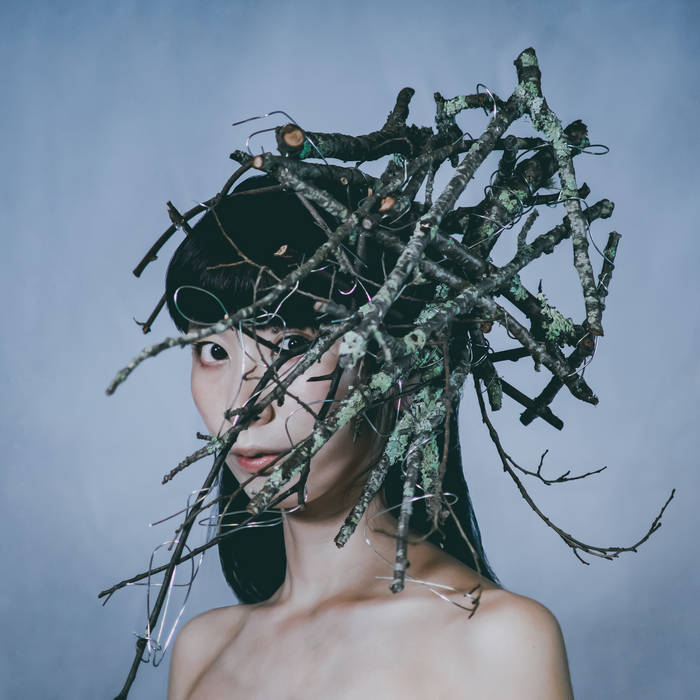
JP ALT presents its first branching dive— An analytical glimpse and introduction to Ai Kamano of Haisuinonasa. Detailing her influences, her extended world of projects, and all areas of art that can be tied into and interwoven with her vision.

When we listen to ‘Logos’ by Haisuinonasa, through the barrage of cryptic guitar repetitions, mathematically intricate galloping of drums, arpeggios of celestially snowy synths, and a frantic bassline trying to narrate a story with desperate emphasis, we can discern a simple piano melody marking the 6/4 time signature of the whole song, becoming the reference point everyone inside the typhoon can use to be on time.
That simple melody hidden in chaos is provided by AI Kamano and serves as the logo for her very characteristic compositional style— uncomplicated melodies juxtaposed against impossibly complex soundscapes. As a visual reference for what this looks like we can use any variation for the “Standing Death of Benkei”, the videographic work of the McLaughlin Brothers for Max Cooper’s “Platonic”, or the paintings of Isabell Schulte.

In these three points of reference, we can spot the compositional techniques of Ai Kamano: A solid theme or backdrop against erratic yet precise variations. In this article we will take a branching dive into Kamano’s discography, providing a starting point for your listening journey while outlining collaborators and sonically compatible artists that will enhance the experience of riding this sweet sonic typhoon.
Ai Kamano (Or “Kamano Ai” in Japanese order) is a vocalist, composer and keyboardist born in the Kagawa prefecture. Her music can be picked up from the following interlocking pieces: her classically trained vocal and piano background from childhood; later formalized through graduate school at the Showa University of Music, and her experimentation with modern techniques such as sampling, synthesis, and post-production manipulation of audio.

Kamano caught the public eye for the first time with the band Haisuinonasa (ハイスイノナサ) in 2005 along Yoshimasa Terui (guitarist/producer), his brother Atsumasa Terui (bass), and an ever-changing lineup of drummers and keyboardists which provided their own shades to the consistent palette of the band. A palette made up of: A sober guitar tone switching between clean fingerstyle picking (‘Moving of Subway’) or schizophrenically fast distorted passages (‘Logos’, ‘Circle’).
Two keyboards, one supplying the main motif of the song and its variations (‘A City of Warmth’) and the other one focusing on embellishing the mix (‘Movile’), drums or percussion either keeping the time with an almost robotic precision in some songs (‘Happy End’) and in others completely ignoring its metric duties to instead tell its own stories, as seen especially in ‘Shape of Water, End of Feature’.
Finally, we’re met with a voice beautified by all this, singing in very mellow soothing melodies (‘Movile’, ‘Start of Wave’). One aspect of this band that is sometimes ignored is the cohesion between their visuals, particularly band photography, music videos, live performances, and their sound. The blending between both senses becomes the most apparent with the video for Moving of the Subway (whose music video won the New Face Award in the Entertainment Division at the 16th Japan Media Arts Festival), and the person responsible for the heavy lifting on the visual side of this song is Keita Onishi, a digital artist who does not intend to make the digital look real, but rather show the digital in its bareness. Two artists that come to mind for this level of detail for what the eyes/ears hunt/catch are Max Cooper and Lusine, bringing symmetrical and calculated experiences filled with personality.
Key works as well as some less well-known gems to get started with Haisuinonasa include:
- Moving of the Subway
- City of Warmth
- Logos (I highly recommend the live video)
- A City Not on the Map
- Homogenizing Landscape
- Reflection
- Let Down (Radiohead Cover)
- Mass
And some works with a sound either influenced or like this band include:
- Chou Chou Merged Syrup – Hakuchumuha Shiisainonai (白昼夢は色彩の無い)
- Jyocho – As the Gods Say (Maniac ver.)
- Paranoid Void – Tadashisa No Yukue
- Siraph – Dilatant

Kamano left Haisuinonasa in February of 2016 but a year prior we see faint shades of her upcoming solo trajectory. It is during this period that we hear a sound less reliant on the guitar as the basis for a rock band, and we begin to explore the possibility of a piano at the hands of a classically trained musician as the lead for a rock band. Something akin to the experimentation of Muse during their The Resistance album, but less reliant on Chopin in this case, and with more tinges of Federico Mompou, who studied the former but expanded on his sound with more gentleness and greater melodic and temporal freedoms.
(See: Variations on a Theme by Chopin: Var. 4. Espressivo, performed by Daniil Trifonov). It is both freedoms that Kamano fearlessly explores in Munou / 無能.
Her collaboration for the Tokyo Ghoul √A OP theme with österreich (オストライヒ): project formed by former “The Cabs” guitarist Kunimitsu Takahashi. A project borne out of the guitarist’s laziness which broke “The Cabs”. Laziness which is nowhere to be found in the song’s 11 time signature changes and 30 Key modulations. A song so precisely made being called “INCOMPETENCE” must be some sort of inside joke. Included in their works for Tokyo Ghoul is a variation of the song ‘Luxurious Bones’ (贅沢な骨), which compresses the original arrangement into the EQ band pass filters, white noises and humming radio distortions characteristic of the Tokyo Ghoul series sound.
In 2018, As a last collaboration concerning the Tokyo Ghoul series; “Rakuen No Kimi” comes to light. This time leaving Kamano the background chorus vocal duties and highlighting that faint light and guitar driven rock left by “The Cabs” inside of Takahashi. Key works and less known gems from österreich include:
- Munou
- Luxurious Bones
- Sign of Domino
- Belief
- Falling Ill
And some works with a sound either influenced or like this band include:
- Floral – Climbing a Wall
- Mudy on the Sakuban – GHOST DOG
- Girlfriends – Untitled #3
This same year, Kamano would lend her voice and piano virtuosity for Majiko (song “Avenir” in her mini album AUBE) and two tracks in the compilation “Classic Parade 2”.
In 2019 Ai Kamano decided to go solo, leaving behind the math rock babel tower she had helped built and soaring with the wings of her album “Muonk”. An album exploiting Kamano’s affinity for sampling and manipulating her own voice which brings to mind a more controlled and minimalist version of Carl Stone’s “Au Jus” or Max Cooper’s samples of Kotomi in “A Model of Reality”, the pop side of syncopation, the feather-in-rapid-winds movements of Anzu Suhara’s (須原杏) violin who brings in her fingers the experience of having worked with Ichiko Aoba (Luminiscent Creatures), Jizue (Jizue jizue* / fox capture plan* – Match Up), and Asian Kung-Fu Generation (プラネットフォークス), the recurring piano themes which may remind some of Steve Reich’s “Music for 18 Musicians” specially in cuts like “Praying End”. Some highlights of this album include:
- 01. Floating city
- 03. Praying End
- 04. Monochrome
- 08. Altar
In 2020, a collaboration with TK from Ling Tosite Sigure took place (Chou no Tobu Suisou), as well as an interpretation of the song ‘Test21 – After The Rain’ in the album Fourth Place featuring Japanese artists such as: World’s end Girlfriend (Rendering The Karaoke Soul) and [.que] (Clear), among others. Kamano returned to österreich to help record “sisi”( 四肢) and provide vocal chops for HYPER SARDINES during their singles and subsequent album release. A collaboration in 2021 with Gecko&Tokage Parade in ‘Polar feat. Ai Kamano’, one in 2022 with Wataru Sato titled ‘The Other Land (Live Version Feat. Ai Kamano)’ bringing equal parts Fourcolor (Thousandth Key) and Arvo Pärt (Cantus in Memoriam Benjamin Britten for string Orchestra and Bell) into the mix, and one last recorded work with DAZBEE titled “Cabo da Roca” in 2024 is what Kamano left in regard to collaborations, focusing in parallel in three main works: Meme Kamano, österreich, and her solo albums.
Meme Kamano being the same Kamano. Under this moniker, she collaborated closely with her husband and longtime partner in sound Kazuki Sugawara. Founder of anre*f: an electronic solo project/Record Label under which Kamano often releases her solo work. The duo released material from 2021 (Land) to 2023 (Sail). Their most prominent work is the Hito Original Soundtrack, a soundtrack that evokes the same autumn creeks and breezes as Haruka Nakamura and Janis Crunch’s “12 & 1 Song”. Some Highlights of this project include:
- Hello Ghost View
- Portrait of Reminiscence
- Distant Voice of Styx
- Holy Sail
- Yureru Komorebi
- Shinkai No Kioku
- Garden After Rain
And some works with a sound either influenced or like this project include:
- Fourcolor – Curves of Air
- Whatever the Weather – 6°C
- Porter Robinson – Wind Tempos
- Yeule – Your Shadow
- Brian Eno & Harold Budd – An Arc of Doves
Regarding her solo works. In 2023 Ai Kamano released the singles “Ghost Grace” and “Karte”. Using her trademark sounds, her synth work shared some similarities with that of Japanese/Argentine singer Annabel (Dear Ghost, Steam Driven Girl). In 2024 she released the single ‘Kaiki’, going back to the roots of a more stripped-down j-rock sound without abandoning her syncopated pianos and strings. These efforts culminated in the album Human, in which she successfully returned to her math rock tower with the song ‘Babel’, bringing all the accumulated experience from previous projects to bring something truly her own.
“Ah, poems amount to so little when you write them too early in your life. You ought to wait and gather sense and sweetness for a whole lifetime, and a lone one if possible, and then, at the very end, you might perhaps be able to write ten good lines.”
Writes Rilke, and this is the sentiment present in her song “Rainer Maria”. A point of condensation and release.
In 2025, along with österreich, the single “Sign of Domino” comes out. In 2026 “That’s Like the Sun” releases, signaling the birth of an album: “Prenatal Stimulation”. Signaling new sounds yet to be born.
Leave a Reply