“The city is our ally and we are its warriors. Reject the darkness now and explode with the city!”
If I ever owned a dive bar, the film Burst City is what would be constantly playing on the TV at any given moment. Released in 1982 and directed by Gakuryū Ishii (formerly Sogo Ishii), Burst City can best be described as a “post-apocalyptic cyberpunk rock musical”. If that sounds like a mouthful, you haven’t seen anything yet. I can honestly say Burst City is one of the grungiest and chaotic films I’ve had the confusing pleasure to sit through in my entire 29 years of life. There’s a certain aura that grows on you in the film that I find intriguing, even if I’m not entirely sure what’s going on at points. Even if you have zero interest in punk rock or post-apocalyptic fiction, it’s hard not to get caught up in the film’s rebellious streak.

The plot of Burst City is somewhat initially hard to describe. The film consists of a series of vignettes of various different residents living in a futuristic dystopia. These groups are made up of power plant workers, bikers, yakuza tough guys and punks. All of them spend their days racing cars, squatting in crumbling buildings and brawling to the sounds of various punk bands. Eventually, the groups all converge together and unite to fight a common enemy, fighting back at the authority figures who’re keeping them down. All the while, Burst City prominently showcases the music of several real life Japanese punk bands of the early 80’s such as Tokyo’s The Stalin, Osaka’s INU and Kyushu’s The Roosters and Kansai’s Machizo Machida.
Director Gakuryū Ishii had already made a name for himself in Japan with his earlier films Panic High School (1978) and Crazy Thunder Road (1980), the latter serving as his senior thesis for university and would eventually be picked up for distribution by one of Japan’s biggest entertainment companies, Toei. While the budget for the film has never been publicly released, visually it’s much more extravagant and impressive than Ishii’s earlier student films. Assembling the cream of the crop of Japan’s punk bands of the time, decking them out in leather and studs, dumping them in a crumbling warehouse and capturing the end results on camera. It’s a movie which sets out to capture the vibe of a very specific time and place, whilst being entirely bonkers and off-the-wall at the same time.
There’s a real cinéma vérité feel to Burst City, especially during the musical performances. The hoards of screaming crowd members, chaotic atmosphere and brazenly anti-authoritarian attitude creates a gritty, albeit somewhat exaggerated snapshot into Japan’s punk scene of the early 80’s. It’s a film that gets by on pure atmosphere and visuals, making up for its somewhat confusing plot with its striking visual aesthetic and killer soundtrack. This is the kind of film that’ll make you want to go buy a leather jacket, take up smoking and start squatting in the nearest abandoned factory. Reportedly, the cast and crew actually slept on the set of Burst City during filming, which must have been rough.

Burst City is shot in this gritty, fly-on-the wall style, captured entirely on 16mm film. It features multiple undercranked shots of cars careening into one another or punks scrapping in various back-alleys, the technique of which would go on to become Ishii’s trademark in his later work. There’s moments where the camera is constantly lurching back-and-forth, creating a disorienting and even sickening viewing experience. Even the camera quality is extremely grainy, as if the cameraman ran the film stock through a cement mixer during the editing process. The dissonance in quality between the viewer and the camera keeps Burst City as it is, a time capsule of the 80s punk revolution, perhaps even a naive glimpse into what these bands thought the future of music was.

The visual aesthetic and set design of Burst City is undoubtedly the film’s most striking feature. If you took Mad Max 2, Streets of Fire and Repo Man, chucked them in a blender, proceeded to beat the shit out of the blender with a metal bat and then throw the end result into a decaying industrial factory, you’d end up with something resembling Burst City. While the cyberpunk elements in the film are quite noticeable, they mainly exist to serve as window dressing compared (apart from the film’s anti-authoritarian streak, of course.)
Unlike Ishii’s earlier works which were strictly low budget affairs, Burst City was his first time working with a major studio. This allowed him the opportunity to populate the film’s hellish sets with a sea full of hundreds of heavily studded extras. There’s even an amusingly choreographed dance number right after the opening credits set to the tune Yufuku no Kiga; a cover of Shigeru Izumiya’s 2 Tone ska song credited to the film’s cast, which was sadly left off the soundtrack album. It’s a very fun sequence, featuring men in drag and bikers skanking around a decaying back alley to the. It almost feels out of place amidst all the carnage and chaos that is to follow.
While music isn’t the primary focus, it’s undoubtedly the driving force behind Burst City. Ishii’s intent was to showcase the music emanating from Japan’s punk scene in the early 80’s and true to his word, the soundtrack is representative of bands from scenes all over the country. My favourite song is Cell Number 8 by Battle Rockers, a fictional band assembled for the movie featuring members from real life Japanese bands THE ROCKERS and The Roosters. The songs have a crudeness to them, but that’s on par for the course for punk from this era. Watching these delinquents piss their lives away in a crumbling industrial hell scape wouldn’t hit the same way if it weren’t for the soundtrack punctuating their daily existence.

Burst City juggles multiple plot threads which occasionally overlap, but otherwise have little relation to one another. This is where the film falls somewhat short as the minimal dialogue, confusing plot and manic editing make it very hard to keep track of what’s going on at times. None of the characters are ever referred to by name and it jumps back and forth between these two groups that it’s very hard to keep track of who’s who and what their relationship to one another is. While the visuals are quite stunning, there’s moments during the second act where it almost feels too abstract for its own good. Yet despite these flaws, it remains a very entertaining movie at its core. It’s incoherent, but certainly never dull.
Over its runtime, the film continuously builds and builds like a pressure cooker until it erupts into a cacophony of noise, guitar feedback and explosions. The chaotic camerawork almost makes it hard to tell what’s going on at points as the film reaches a fever pitch. The last 15 minutes consists of an extended riot sequence where the characters get their revenge on the oppressive authority figures who’ve been a thorn in their side for the entire film, it’s just insane. What you see is what you get and you’re either onboard with Ishii’s madness, or simply repulsed by the lurid imagery on display.

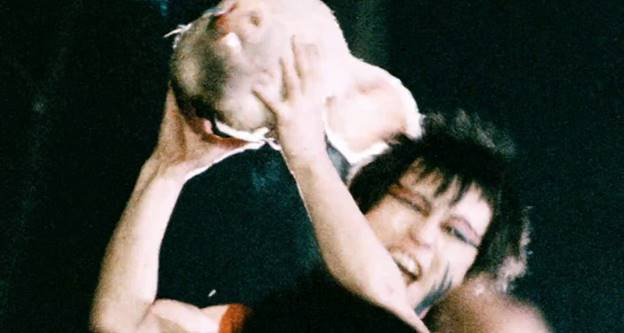
Once the film gives up any pretense of having a coherent plot, it becomes all the better for it. The third act devolves into a literal battle of the bands, with leather-clad punks clashing with futuristic riot police. There’s one memorable visual where The Stalin front man Michiro Endo throws a severed pigs head at a police officer, mirroring an act Endo performed onstage in real life. All the while, the bands continue to play music until their dying breath, defiantly giving the middle finger to the pigs ‘til the very end. Music is their escape from this miserable life and is ultimately undoing, but damn if they aren’t gonna go out with a bang.

Burst City is not a film for the fainthearted. Incredibly ugly both thematically and visually, it’s the kind of film that grabs you by the balls and simply refuses to let go. It’s Gakuryū Ishii tearing up the rules of film making, pissing all over them then picking up the pieces to suit his vision. You can feel Burst City’s DNA in works as diverse as Katsuhiro Otomo’s cyberpunk touchstone Akira (1988) and Shinya Tsukamoto’s cult-classic body horror Tetsuo: The Iron Man (1989). But if you can get onboard with Ishii’s chaotic editing and the film’s anarchic spirit, you’ll find a lot to enjoy here. Ultimately, it’s just something you have to experience for yourself.
Leave a Reply