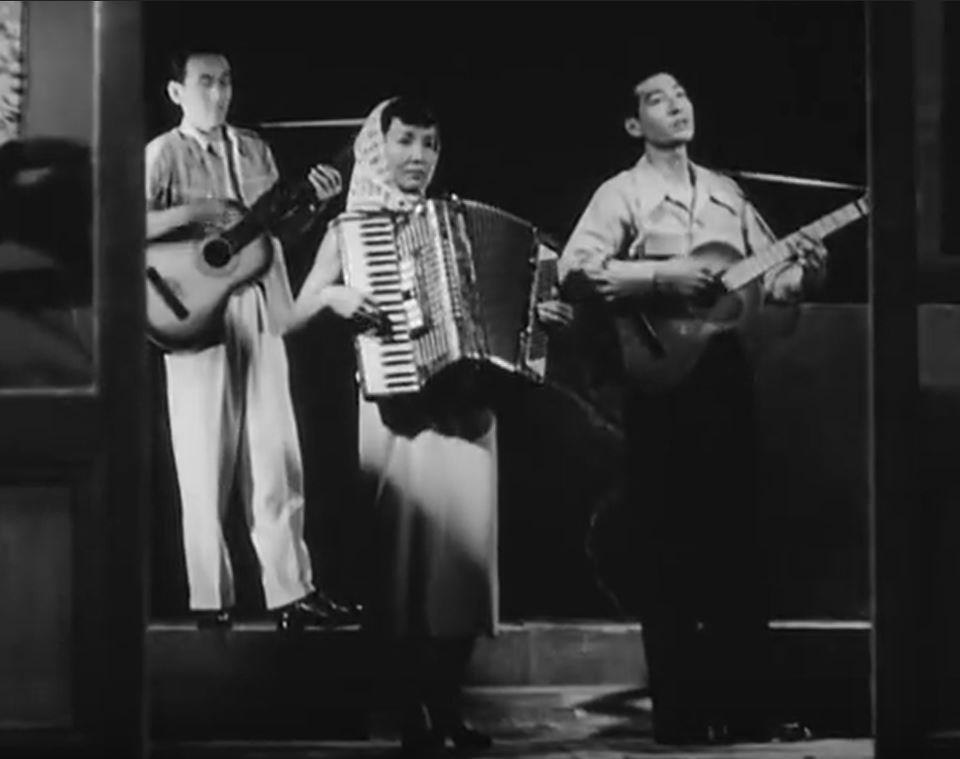
From Shinjuku to Taipei, Nakasi was the raw, analog heartbeat of the East Asian working class. It was ‘Early Taiwanese Jazz’ that breathed with the working class, a “rustic and urban-rooty” soul fighting its final battle against the silent-roar of the digital age.
Shōwa-era Tokyo— a concrete jungle where neon lights intertwined. Before electronic perception and technological humming entirely occupied the nightlife, there was once a sound that defined the nights: “Nakasi.” Derived from the Japanese verb. “Nagashi” (流し), meaning “to flow,” Nakasi artists were like water flowing through the cracks of the city. With their accordions and guitars, they drifted from the smoggy Izakayas of Shinjuku to the hot spring hotels of Beitou and Taipei. They were not merely “accompanists”; they were the soul of the nightlife, carrying a vital heat that cold machines could never replace.
As a Taiwanese, Nakasi is a familiar name, yet I feel its distance deeply. Today, few active artists remain in the field, most are in their 70s or 80s, or have been forced into other industries just to survive the mechanical tide. For my generation, born under the reign of the Karaoke machine, Nakasi is a precious relic. It represents more than just the cultural blending of the Japanese colonial era, it is the early blueprint of “Taiwanese Jazz.” It stands as a witness to how the space for human live performance was gradually stripped away by automation. Nakasi is fading, but I refuse to let this sound vanish.

The essence of Nakasi is deeply rooted in working-class culture. Early 20th-century Tokyo was like a giant, accelerating engine. Workers, exhausted by the relentless labor of the day, would retreat into the narrow alleys of Shinjuku, seeking respite in cramped Izakayas or bars. Music and singing are forms of arts with high cohesion and accessibility, thus becoming the melodies hummed after a hard day’s work. This defined the grassroots nature of Nakasi. As Taiwanese musician 林生祥(Lin Sheng-hsiang) described:
“Nakasi is a very special form of band and musical style which received profound Japanese influences linguistically as well as musically. It’s a very rustic and urban-rooty form of music, normally with a keyboard, which has replaced the accordion, and drums accompanying the singers.”
Nakasi artists didn’t serve the elites in grand theaters, but they served the laborers in tea houses and cheap bars. For those whose senses and emotions were daily alienated by machinery and toil, Nakasi was one of the few outlets for the soul.
Nakasi musicians didn’t chase perfect pitch, they chased resonance. In an era before the birth of the Karaoke machine, music relied entirely on live music and jamming. An artist carried thousands of songs in their head, from military marches and folk tunes to Jazz and the rising Kayōkyoku (pop). They could follow any patron instantly, adjusting their rhythm and key to catch a drunk customer’s off-key wailing. This ability to breathe with the audience nourished future Enka legends. This imperfect, sweat-stained “live-ness” is the primal, alternative root of early pop. It never belonged to the polished record industry, yet it belonged to the streets and the sweat. Even in Ozu Yasujirō’s film Tokyo Story, the presence of a Nakasi band hums in the background.
Through the warm currents of hot springs, Nakasi crossed the ocean in the Japanese ruling era of Taiwan and found its most fertile soil in Beitou. Originally, Beitou’s hot spring hotels were elite social spaces featuring Geisha and Shamisen. But as society transformed, affordable inns and tea houses rose, and Nakasi completed its localized mutation. The Shamisen was replaced by accordions and guitars, electric organs and saxophones were added at its peak, creating a rich, distorted, and psychedelic wall of sound. Because of its inherent improvisational nature, it was later called “ The Early Taiwanese Jazz.”
But the good times didn’t last, the invention of the Karaoke machine rang the death knell. Mechanical efficiency and cost-cutting pushed live musicians out of venues. Also like its Japanese origin, Nakasi’s survival space was tied to the nightlife and the sex industry. In the 1990s, the Taiwanese government’s “Abolition of Prostitution” policy cleared out tea houses and brothels. Since then, the voice of Nakasi has weakened, the stream nearly dried up.
This decline forced musicians into roles as security guards, cooks, or taxi drivers, or performing in temple plazas in front of nearly zero audiences. The most heart-breaking example is Li Ping-Huei (李炳輝) , the blind musician behind the classic “Odyssey.” (流浪到淡水) A former Nakasi performer, he fell into a desperate struggle for survival after his stage disappeared. Even though his song is really well known even until today, he struggles for his basic livelihood. Technological evolution has indirectly become an accomplice to structural violence. Is our “civilization” a brilliant achievement, or a cruel devastation?
Yet the soul of Nakasi will not simply vanish. Elderly Taiwanese have formed “Nakasi Fan Clubs,” (那卡西歌友會) on Facebook, where dozens of videos are posted daily, raw, unpolished, and full of life. More importantly, Nakasi’s DNA has seeped into the blood of contemporary musicians. Lin Sheng-hsiang inherits its “rustic and urban-rooty” grassroots spirit through his arrangements and themes, capturing the pulse of the marginalized. Chen Ming-chang channels the essence of “Taiwanese Jazz,” turning the scent of liquor and sulfur into an era’s sorrow with just a Yueqin/Moon Lute and a guitar. Meanwhile, Blackhand Nakasi has radicalized its proletarian spirit, turning Nakasi from a banquet accompaniment into a weapon against structural violence, a declaration that Nakasi has always belonged to the struggle and the sweat. Nakasi as a form may never regain its former glory, but its soul has transformed into another shape, continuing to flow restlessly. One day, it will reach even further.
Recommended Listening:
- Lin Sheng-hsiang, Takashi Hirayasu, Ken Ohtake – Planting Trees (林生祥, 平安隆, 大竹研- 種樹)
- Chen Ming-chang – Chen Mingchang’s 2023 Soundtrack Trilogy. (2023陳明章電影配樂三部曲)
- Blackhand Nakasi – The Poor’s Dinner(黑手那卡西- 窮人的晚餐)
- Li Ping-Huei – Odyssey (李炳輝- 流浪到淡水)

Leave a Reply