The year is 1984, and the world is moving incredibly fast. Everyone is carrying a Walkman, listening to new music and AOR, and adjusting their eyes to the bright neon lights that weren’t on these streets before, or at least not in this density. Young people frequent clubs, go on late-night drives in stylish cars, and live their best lives in the bubble.
However, something stirs within these people. No matter how much opulence they inhale, they are still scared. Fear of automation, of atomic bombs being dropped across the world, of technology that is new and powerful but extremely unpredictable. Some people’s minds drift toward Orwell and his vision of the current year, and they come to a horrifying conclusion: They could be living in it right now. And during this very symbolic year, P-Model released an album that doesn’t just criticise systems… the album itself was the system.
Another Game (1984)

Yasumi Tanaka had left the band by the time Another Game was released. This was a big blow for P-Model, as Tanaka had been one of the pillars of the band since the Mandrake days. Another Game marks the first time Hirasawa was the sole composer and lyricist (aside from Syd Barrett of Pink Floyd, which will be explained later). Unbeknownst to anyone, this was the first step towards Hirasawa’s transformation into the architect, whom we know from his solo work. As Hirasawa himself stated in 1989, this shift was indeed due to Tanaka’s departure. He also said that he doesn’t really remember the album’s creative process. Keep that in mind, as it’s something that will support further interpretation of the project. Another Game came out as a cold and oppressive piece, seeping with symbolism. Let’s unpack it. Get ready to become brainwashed by the horror of Another Game.
The opening track, ‘Another Game Step 1,’ is not necessarily a song. It is a guided induction into a meditative state, which is rather unsettling, even if you don’t understand what the speaker is talking about. The speaker, who is an unnamed friend of Hirasawa, instructs the listener to sit comfortably and close their eyes. After uttering a few sentences, he tells you that you have “entered a state of relaxation.” This would be quite comforting, if not for the ominous clicking sound and a quiet, dark synth in the background. But the real killer is what he is actually telling you. The voice transforms into something that has control over you, something akin to a scientist or a priest. During these three minutes, you’re being primed in real time. After you’ve relaxed, you’re being told to imagine a few situations. The first one is a loving family man who works at a weapons factory, which is the first moral contradiction in a series of many. “The world cannot deprive him of his job / the courteous loop between the world and this man” are the lines that describe the man’s situation to the listener – he exists in a loop that benefits him, but traps him at the same time. The man produces weapons, the system rewards him, and his morality becomes irrelevant. Then, you are asked to attach your own “personal keywords” to this description, something you’ll be asked to do a lot of times during this track. Another story is of a scientist who engineers a project to help humanity escape into outer space; his reasoning and technology are the same. This can be tied back to the weapon maker, with his weapons possibly being the reason for humanity’s escape. Again, you need to apply your own personal keywords to this.
The personal keywords allow you to attach your own emotions to these hypothetical situations. By encoding these moral contradictions into your own mind, this, in turn, lets you become a part of them. You’re then asked to find similar cases to these two in your daily life. The conceptual “virus” has already been planted. The speaker can perhaps feel your discomfort by then, so he tells you that “if it seems bizarre to you, consider this feeling, your present self experiencing this feeling, the state of your flesh, the state of your mind, and at any time you feel, please apply your own personal keywords to remember this by”. You aren’t even safe in your own mind anymore. Your discomfort is simply another observable state that contradicts your relaxation, and you essentially become mere data. At the end, all of this is wrapped in a nice, shiny idea of enlightenment with “I look forward to your new worldview”. Your psyche has already been rewired, and your “new” worldview is not exactly yours. You might have thought that this process of brainwashing would take the whole album, but no, they already got you on the first track. The voice ends the biofeedback with a simple: “Now, please enjoy the music.”
Then the music hits, and it hits hard right out of the gate. ‘Holland Element’ starts with a thick and muddy bassline before it evolves into a cold, droning cut. Lyrically, the song switches the attention from the mind to the flesh. After the hypnosis of the introductory track, the individual finds themselves as a biological component in an industrial machine that seeks to exploit them. Capitalism is a key factor in that machine, a concept incomprehensible to the individual, made apparent with the verse “I earn money I don’t understand / I gain possessions I don’t understand […] Unable to recall the original process.” The chorus states that one’s existence is “Helplessly possessed by Mononoke,” which is the yokai representing the modern system overtaking a person’s mind and body. A callback to track 1’s weapons factory is placed in the next verse with “The sound of a pistol shot in the dark / Wonder whether a stranger died or not,” signalling detachment and inability to feel empathy for others. But what is the actual Holland Element in the song? The inspiration behind it stems from a 1774 mistranslation of a medical book.
The final two sentences of the second verse are: “Elements imported from Holland / My nose is surely verhevene.” The “verhevene” part in the original sounds more like “furuhehendo.” If you have already listened to this album, you might know why this one is important. The phrase “furuhehendo” comes from a medical book called “Kaitai Shinsho”, or “New Text on Anatomy.” Written by Sugita Genpaku, it is mostly a translation of the “Tabulae Anatomicae” published in the Polish-Lithuanian Commonwealth and written in Dutch. Japan at the time was still under Sakoku, the isolationist decree of the Tokugawa Shogunate, extending for nearly 300 years. During Sakoku, the only permitted Western influence was a Dutch factory on Dejima, which was the island that served as the only Japanese territory open to foreigners. Because of this, the Rangaku movement (“Dutch Learning”) became popular amongst scientists. With Rangaku, Japan was able to get its hands on the latest technological, scientific, and philosophical advances from Europe. Allowing the Dutch to be in Japan was also (provided a goldmine of knowledge for the Japanese.) a jackpot. This is because Europe was struggling with the Protestant Reformation, while the Netherlands remained a free state full of independent thinkers.

“Tabulae Anatomicae” was translated in 1774, at the request of the shogun himself, and it quickly became an incredibly important book. There was one issue, however, as none of the scientists working on the translation spoke fluent Dutch, which gave birth to a few mistranslations or, more importantly for us, rather flawed transcriptions of some words. One of the problematic words was verhrffende, which is the inflection of verheffen. After countless cross-references, Genpaku was unable to find the meaning of the word and decided to use it to describe the shape of a breast, using the word “furuhehendo”. Verheffen later found its rightful place, describing nose problems.
This history lesson was important to understand the context behind the nonsensical “furuhhehendo,” and the elements imported from Holland finding their way into the speaker’s nose. In the song describing the possession of flesh by an unknown force, the “furuhhehendo” is an error that became real, embedding itself into flesh and mind without consent, and as stated in verse 1, “unable to recall the original process” of its creation. The track showcases the possession of the subject after their skull was opened in track one. The mononoke is wrong enough to feel like something’s off, but comfortable enough to keep on going. The “furuhhehendo” feels almost like an unfunny punchline.
‘Atom Siberia’ is the next track, and it exists to show us “furuhhehendo” doing its damage on the body, but this time physically. The song itself was controversial, and it pushed the album’s release back by 3 months. The Recording Institution Academy of Japan objected to the usage of the words “malformed” and “objected” in the song, as these words are most commonly used to describe damaged bodies. This meant the song had to be recorded from scratch. The activation of the censorship machine proved Hirasawa’s thesis in the real world, with the song about the corruption of the body on the atomic level ringing the alarm bells of the system.
The song, again, sounds off, like every song on the album. The synths and distant vocals evoke the extreme freezing temperatures of Siberia, which carries a massive symbolical weight: Soviet labour camps, isolation, exile, and the Trans-Siberian Railway (loosely mentioned in “Train” from Perspective, however, the actual reference was to a train running through Arctic wasteland, and it’s easy to make a connection here). So, Siberia, in the minds of many people around the world, is correlated to a cold, desolate place where the Soviets were sending bodies they wanted to destroy. ‘Atom Siberia’ serves as the end of the initiation phase, with the foreign particles replacing what makes you human.

The next song is ‘Personal Pulse’, which is rather groovy. Still, the song is quite repetitive, something you might encounter more frequently as the album goes on. This repetitiveness is, in my opinion, not exactly the album’s flaw if we take the narration into account. The lyrics start with an image of the speaker going through dark woodlands, and with the music’s sense of anxious urgency, it creates an image of a lost person going around and around. Hirasawa’s vocals are distant and echoing, like a specter trapped in a room, disappearing only when the air around decides it should dissipate.
The song was originally titled ‘Radio.’ Lyrically, the image is exactly of the body becoming a radio, which means no output, except for the ones already caught and processed by it. The passivity of the body is made apparent with the lines “Without contemplation / Without a plan / My body becomes a radio,” which is quite ominous. This is amplified even further with the singular “I LOVE YOU” uttered at the end of the track, either the last original thought of the individual, or, more ominously, the phrase was processed by the mononoke as well. With the latter messages we receive from the album, I’d interpret it as a deliberately ambiguous case.
Next, we have the most radical and, on the surface, nonsensical song on the album.
“Furuhehehe” might not even be a song at all, now that I think about it. It’s more of a signal, or a demonstration of the new state of the speaker. The lyrics are as follows:
“Furu-he-he-he-he / He-he-he-he / He-he-he-he / Moo”
On loop for 3 minutes. The previous tracks were all theory, and this one is the practice of how the body sounds when it opens its mouth. The language and the meaning; it all gets corrupted. As explained before, “Furu-he-he-he-he” is the perfect word to demonstrate the results of the process. It simultaneously is a word and isn’t a word. The word exists, and a meaning was applied to it, but the word itself is made-up, artificial, and it should not exist in the first place. Even the “moo” lands heavily here, as it isn’t a proper word but simply an onomatopoeia. It is a human rendering of the sound that a cow makes – something created by humans to describe a sound that has no place in our language, is nonsensical for humans, and is used by cows who speak a different language from us. Now, I am not comparing the Dutch to cows, but the case with verhrffende not being understood by Genpaku and his crew being transformed into “furuhhehendo” is quite similar to humans creating their own “word” for a cow’s cry.
The constant repetition of “furuhhehendo” means that the body itself became a mistranslation. It also serves as a reset of the narrative: no more theories or failed inputs, just the purest controlled madness. Every argument made before that track has collapsed thanks to gibberish, and now, well, you just have to enjoy your new life as an asset. So, how’s life?
Life now is apparently that of a Pink Floyd cover. But not just any cover! It is a cover of a song written by the infamous Syd Barrett, with Hirasawa changing up the lyrics and going into a surreal atmosphere. The song, ‘Bike,’ is still whimsical and happy in sound. The lyrics are still about giving everything to someone (or something…?) so that they stay, however, while Barrett offers a bike, a coat, or a good mouse called Gerald, Hirasawa refers to heads of Einstein and Christians, a “psycho coat,” or a Yayoi caveman that sits in a crowded bus. The intent is still there; the chorus says “When I really look at it / You’ve always been there / I’ll give you anything / So always be there”. Not much has changed from Barrett’s original “You’re the kind of girl / That fits in with my world / I’ll give you anything / Everything if you want things” except for the sheer creepiness of the request.
Barrett wrote this song in 1966, 2 years before he left Pink Floyd. By 1984, he was a recluse, disappearing from the public eye until a short appearance in 2002. Covering ‘Bike,’ Hirasawa makes contact with the ghost of Barrett, who, by the time of the album’s recording, became something akin to what this album tried to create out of the speaker. Just existing, receiving signals, but still unable to act (like during his final shows with Pink Floyd, where he was just pacing around in a drug-induced haze without playing), succumbing to a catatonic state of mind. The song being a cover is exactly what this album is about; the exterior remains mostly unchanged (‘Bike’ still sounds like ‘Bike’), but the interior is completely different. The next track, ‘Harm Harmonizer,’ closes the first disc with a distorted audio of people clapping and cheering over radio static. The room that ends Barrett’s song becomes a place for a contorted applause. The title, ‘Harm Harmonizer,’ suggests that this room is full of output that is supposed to calm the speaker with artificial praise.

‘Mouth to Mouth’ introduces a second speaker- a female voice, courtesy of Manami Takada. She repeats the song’s title repeatedly, with Hirasawa swaying between her phrases like he’s about to have a panic attack. The lyrics are not really elaborate; the entire text is “Mouth to mouth / harm to harm / talking about the usual / talking about that idea / talking through your radio,” and that’s it. But with “mouth to mouth” placed next to “harm to harm,” we can make a direct physical connection, be it a kiss, a conversation, or resuscitation, which becomes dangerous enough to be flagged by whoever controls the system. The damage that might come from it is mutual and structural. “Talking through your radio” is a callback to ‘Personal Pulse,’ where the speaker’s body becomes a radio.
The entire conversation of “Mouth to Mouth” reminds me of early AI. Remember Cleverbot? Remember when you and your friend decided that it would be a great idea to hold a conversation between two cleverbots, and they either were stuck in a “hello” loop, or they’d immediately start to threaten and abuse each other verbally because that’s what the most common input for them was. People would log in, tell the bot to go fuck themselves, and the robot would then process it as a viable start to a conversation. Kind of the same thing is happening in ‘Mouth to Mouth’, but instead of verbal abuse, we get carefully created constructs that don’t cross the line of what’s acceptable to the system. Control at its finest!
‘Floor’ is the longest song on the album, and the most carefully crafted one as well. This thing really drags and traps you in despair. When I listen to this track, I feel like I’m in a place of no escape; just utterly hopeless and stretching for kilometers. The chorus is repeated all the time, but throughout the track, it introduces some major changes to its lyrics, namely “I love you / I shoot you / I save you.” These switches are seamless, and despite being contradictory to each other, they just happen as a natural progression, perhaps the only available one. The floor is stated to have existed for thousands of years. It predates me, you, the speaker, the system, possibly even society. The floor doesn’t react to what is happening on it; it’s indifferent. And in this song, it contains two bodies that do contradictory acts to each other. The floor could be a base of human relations – it is stated that on this floor “lovers suffer from disease,” “look into each other and go insane.”

The “love/shoot/save” section is made of three contradictory acts; however, even the sequence in which they are placed is a contradiction. “Shoot” being in the middle of “love” and “save” doesn’t make much sense. If it went like “shoot/save/love,” it would signal redemption. “Love, save, shoot” would mean deterioration. In ‘Floor,’ “shoot” is plastered between two redeeming acts, so it’s like a part of the loop, where these three notions are not discernible from one another. The disease the lovers go through is probably possession, which allows them to only love, shoot, save, love, shoot, save each other for thousands of years. On a musical level, ‘Floor’ contains synths and basslines taken from 1979’s ‘Art Mania’, but slowed down a few levels. The roomrunner of ‘Art Mania,’ the same one who was acting on his desires for a person that became so extreme he could set a museum on fire for them, is exhausted.
‘Goes on Ghost’ is a very human track. The speaker here is exhausted with actions that bear no fruit, with dreams that are getting unreachable. This track perhaps serves as a memory hidden behind the inputs and outputs that’s been filling his mind. He remembers the dreams and mourns that he is still in the same place, unable to get any closer, still trapped in the same loop of swinging and missing. Track 1 already accustomed us to this “courteous loop between self and the world,” in which infected individuals became assets to the system with no free will. They are simply a mission to complete for the system. The second verse contains a lyric: “residing in a riverbed of iron fate / brings nothing, not an answer / for you who can’t seem to die,” clearly hinting at the inevitability of fate that’s been wired into the speaker at the very beginning. “Who can’t seem to die” is connected with the chorus, a repeated “goes on ghost,” looping around, sometimes broken by an encouraging “let’s go”, a highly ironic phrase, because going in one’s current state means continuing in the unbreakable loop.
The final vocal track of the album, ‘Echoes,’ starts with a droning guitar static and the words “Supermarket Symposium” – two institutions that replace the plaza that is mentioned as dying in the first verse. They’ve become equivalent, despite being so different. In a supermarket, you passively breeze by and buy things you need, while in a symposium, you drink together and philosophize. A symposium (coined by Plato) feeds your mind, and a supermarket feeds your body, but in a system where both are infected, they’re effectively the same. In a symposium, you produce something with your mind and contribute to a discussion, while in a supermarket, you just buy products that are already there. Even if you’d say something at this modern symposium, it would not be anything new, just a pre-existing input.
‘Echoes’ is also extremely direct, thanks to phrases like “there is no way out,” “though I’m just talking,” and “I am echoes” are the dying thoughts of an autonomous mind being flooded by inputs. Especially important is the “I am echoes” line, which acts as a thesis statement of the entire album. The final track is titled ‘Awakening Sleep α click.’ On the surface, it is a simple, nice ambient track. However, on physical editions, the track loops after a certain point, without stopping. It’s endless. The echo does not decay; the loop is placed at a point where it becomes seamless. And you, the listener, become trapped in this loop, unless you decide to switch your device off, stopping the album manually. Maybe there is a way out of this loop after all…
Scuba (1984)

I was sitting at my desk once more, thinking over my fears. Then I let myself drop. Suddenly, it was as though the ground literally gave way beneath my feet, and I plunged into the dark depths.
– Carl Jung, 1913
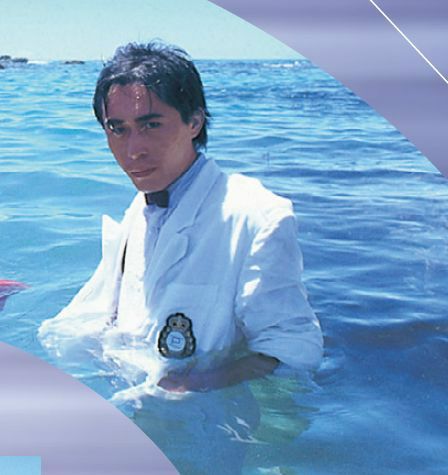
In 1984, Hirasawa started to become increasingly tired of major labels. The issues he’d experienced during the making of Another Game weighed on him heavily. Constant pressures from both the label and the Recording Institution Academy of Japan were just the start of his longstanding problems with the system that he’s been fighting against. So, he decided to let himself drop and create Scuba in Akira Kamio Arishima’s room, instead of opting for a studio again. Scuba was released as a cassette book through the JICC Publishing Bureau, which allowed them to bypass the RIAJ’s censorship. The booklet attached to the album contained 84 pages of the lyrics and short stories attached to them (beginning the Hirasawa tradition of writing a story to go alongside the album), techniques to induce hypnosis and REM state, and an interview with The Stalin’s Michiro Endo. It also included photos of the band in a coastal setting.

The techniques contained in the booklet are mostly based on Carl Jung’s philosophy, and their inclusion connects Scuba to Another Game perfectly. Another Game hypnotized you from the start using the Silva Method for malicious purposes. Scuba, on the other hand, gives you a choice and offers you help in attaining the state of meditation for your own benefit. The booklet’s techniques are suggestions, not impositions, and you have to follow them by yourself. The booklet is now a rarity, with copies available to buy either not containing it or being priced at astronomically high prices. Sadly, I wasn’t able to find any copy to get or contact anyone who is in possession of the booklet, but I will try my best to explain Scuba’s message anyway.
‘FROZEN BEACH’ opens the album, and we find ourselves in a meeting place. This is suggested by the opening line, “The place where we first met was this frozen beach.” In our most surface-level consciousness, a frozen beach is a paradox, with a beach bringing forth an association of hot weather, vacation, and fun times. Here, the beach is frozen, not a rare event, but in our minds, this image is quite unnatural. A beach is also a threshold between the seen (the world around us) and the unseen (the deep water). Since the water is frozen, this threshold can’t be crossed. The speaker stands at the edge of something immense and finds himself capable only of wonder and shame. The register is reverent, as both the water and the beloved are addressed with wonder. For example, take the lyric “let me shed one tear from ancient times.” The tears are ancient, belonging to a time before the self was a separate thing at all.
‘FROZEN BEACH’ in itself is a rarity, since it’s a love song– something Hirasawa creates sparsely. Still, the love described here is closer to the sublime, with the speaker lost in thoughts of wonder and awe, and constantly using words that signal inadequacy rather than connection. Still, this description is a painfully honest one,the presence of the lover makes him feel ashamed of himself, like one is ashamed when encountering something of divine proportions. He stands next to this person and realizes that he is insufficient. The song was written on the Makuhari coast, north of Tokyo, which suggests the encounter and the feelings that arrived with it might have been real.

Something to remember is the line from the second verse: “the frozen beach between science and prayer.” This essentially acts as the thesis statement for the entire album. A lot of the album’s later themes stem from the conflict between the empirical and the devotional. The final verse starts with “As our relationship deepens, we no longer need words.” Now, first, I got some flashbacks from Another Game’s ‘Mouth to Mouth,’ and knowing that Scuba also revolves around hypnosis, it should be something to be wary of. But let’s leave this song alone for now, and move on to where the tide is taking us next.
‘BOAT’ is genuinely such a weird song, in the best way possible. It sounds so cheerful, almost like an old disco song; it’s a bit folky and kitschy. The chorus is a whimsical “SAIL BOAT SAIL BOAT / let’s all be friends,” and it really gets into your ear fast. It’s one of those low cortisol songs. But remember, we are listening to P-Model, and the song is actually about cannibalism and identity erasure. ‘BOAT’ is in the point of view of someone who actually managed to leave the frozen beach and go out into the ocean– the boat was built by the speaker, loaded with the best things he had, leaving on a journey. Well, the speaker is not really a philosopher, so the chorus is the most earnest diplomatic statement possible: Unfortunately, it fails. Thrice.

The first voyage fails immediately upon docking onto the land. The boat arrives at the port and is not to the liking of the people there, and they start to set the boat’s keepsakes on fire. These keepsakes, which were meant for the other island, are abandoned. The Scuba booklet gives you some background to this journey. In this song, a young man called Succhan (our speaker) decides to visit a neighboring island that is filled with… cannibals. They eat anyone who doesn’t look like them. Succhan manages to meet the chief of the tribe, and he interrupts the happy shanty with philosophical questions: “Where’s the ocean’s bottom?” and “What is the destination of your painstakingly crafted boat?” After posing this question, they drown Succhan’s boat. As per the booklet, Succhan is eaten by the tribe, and they decided he is so delicious that they need to eat the rest of his tribe too…! His tribe gets the whiff of the incident and takes cover by making themselves look like the cannibals. The cannibal tribe arrives at Succhan’s tribe’s island in their very own painstakingly crafted boat. However, they are so confused that they leave. Both sides end up calling each other demonic, crazy, and alien, which causes the loop to continue. Succhan’s tribe decided to keep the camouflage for a long period of time, as they are afraid of the invaders. BOAT was remade in 2011 as ‘Genshiryoku’, and we will return to this story once we reach that period.
‘七節男’ (Seven Jointed Man) follows the themes of the previous song, with the most prevalent one being mimicry. In sound, this one is quite unsettling; in lyrics, it’s almost religious, but in a very cultlike way, which is still unsettling. The song talks about the “seven jointed men” and their “seven mysteries.” We don’t learn much about them, besides the reason we don’t notice them anymore is that they resemble us in great detail. They have no king, no god, no self, and what remains is only the seven-jointed man, and he himself is nothing. The number seven is especially striking to me here; it is a number that carries great weight in almost every tradition; Abrahamic, Pythagorean, Mithraic, in all of these, seven is the number of completion. So we can assume that the seven jointed men are complete in their nothingness, as well as complete in their mimicry. The seven jointed men are perhaps the tribe that Succhan was a part of, and that would line up with them forgetting themselves due to wearing a mask of the invading tribe for too long.

‘OHAYO II’ is a rework of ‘Ohayo,’ the opening track of Landsale (1980). Here, the lyrics are a bit different, and the song feels like a return to the frozen beach, almost like a break from the tribal collective unconsciousness. “Ohayo” means good morning in Japanese, perhaps the simplest thing that can ever be uttered; a simple, warm greeting. Morning (or by the time you’re waking up, it might not be morning if you have a messed-up sleep schedule like me) is the time when your brain is most active while asleep, and because of it, you enter a REM phase of sleep (rapid-eye movement). The song itself is a hypnotizing one (especially that floating synthline, which is so gorgeous), and it makes you feel like you’re just waking up, still groggy and confused. So, the first line of the song is “Into that good morning where we dissolve,” suggesting that the lover is something existing only in the dream of the speaker. Also, lucid dreaming is at its most achievable state during REM, with the hypnagogic state at its strongest. It’s possible to sleep into the dream and semi-consciously walk into the dream, in this case onto the frozen beach where the said lover waves at you. The final verse has the speaker say goodbye to the lover, but the goodbye isn’t final; it’s more of a “see you later.” He also bids her farewell on his own accord; it is not imposed upon him. Two people saying goodbye to each other before returning to their unarmed, physical selves, which in this case is not temporary, as clearly the dream is the place where the speaker wants to be.
Next is ‘LOOPING OPPOSITION’, which starts with a spoken word segment from The Stalin’s Michiro Endō (such an interesting collab!) Endō’s section is fascinating because if you know The Stalin, you know they were up to some insane things, to put things lightly. The band was called that way because Endō himself said that Joseph Stalin is one of the most hated people ever, and that’s good for their image. You can read more about them in our review of Gakuryu Ishii’s Burst City (link). In ‘LOOPING OPPOSITION,’ Endō’s opening is very raw, with him telling his lover of his wounds that were created because of a dysfunctional relationship. She is, at the same time, loved deeply and unbearable, but the two keep returning to each other, learning nothing, allowing the loop to continue.

Endō’s presence might feel random at the beginning, but it actually makes so much sense. The Stalin’s modus operandi was to rupture, to make uncomfortable, to confront. Here, Endō does not express his rage, but exhaustion. The greatest provocateur in the history of Japanese punk reads a poem about attachment that can not be resolved. The irony of the hardest voice in Japanese underground falling victim to this particular loop is devastating. Hirasawa and Endō have also released a single together in 1984, named “Ki-Ga Ki-Ga Ki-Kyo”, which sounds like it could have a place in an alternate reality version of Scuba, where the album goes into a darker, more unsettling direction.
Then, Hirasawa enters the stage with the chorus that, you guessed it, keeps looping. Between these repeats, three unsolvable problems arise. First, a calligrapher’s problem. “Written across the opposing poles in one unbroken stroke / an illusion, illusion, illusion.” The one unbroken stroke – in the lyrics “一筆書き” (ippitsu-gaki), is a traditional word to describe a drawing or a sentence made by one stroke. It continues the two opposing poles, connecting them despite these poles being opposites of each other. What this one unbroken stroke creates is an illusion. The second problem. “Faint somehow and find it, faint somehow and love it, making do until it’s vanished / the real me,” might be a description of the seven jointed men’s condition, whose real self just vanishes quietly under the layers of something done in faith and care. You just live your life, do something you love, and the real you eventually vanishes. The third problem. “Everything’s fine, that makes it fine,” repeated a few times in the second and third verse, is an incantation that sounds awfully like something made to protect the one who says it, but turned into apathy afterwards. The ego surrenders to the loop, which is being called “the God’s method” back in the first verse, and with this revelation, we learn that the loop exists to serve a system.
‘REM SLEEP’ comes after this, and it’s just six lines. But these six lines are the entire album. Everything that preceded this song: the frozen beach, the sinking ship, the tribe wearing the faces of the others out of fear, all is bundled up here in just six neat lines.
“Turning into a bird
Turning into a beast
I’ll remain me and become you
Good night, or in other words,
Hello
REM sleep”

First, we have two transformations, which are a direct application of Jungian philosophy within the album’s context. On a surface level, these two seem like a loss of self, but we are not on the surface anymore; we are deep into this ocean of consciousness. The bird and the beast symbolize a return to the pre-rational self that the social persona can’t accommodate. “I’ll remain me and become you” is a sign of protest, with the speaker not succumbing to vanishing into the collective or the beloved, but rather becoming someone else while retaining their own self. The self is not destroyed by interacting with the others; the self is destroyed by either succumbing to the others completely or by closing off to the outside world; either becoming everything at once or nothing at all. I remain me and become you: both can be true in REM sleep. “Good night, or in other words, hello” is simple – once you enter the REM state, you are not pulled away from your life, as your body lies asleep, but your consciousness is still active.
‘FISH SONG’ is the resolution of the album, and also one of my favorite Hirasawa tracks (although I prefer the Ghost in Science version). We finally find each other at the bottom of the sea, crossing the threshold of consciousness. What we find there, instead of the promised void, is a school of fish. Ancient, luminous fish, moving for the sake of movement. There is a beautiful togetherness in this idea. This section will be rather long because I really love this song and it is packed with symbolism and beauty, so bear with me.
Verse one starts with “An eternity’s thoughts, the past, present and future / Dwelling in the water’s shade, to be thought of is to live.” This shows collective unconsciousness in practice, with the thoughts dwelling in the shade as a school of fish, together, unbroken. These fish have existed way before the speaker was born, way before society was born; they are the thoughts of your ancestors who were bashing the rocks together to create fire and painting a mammoth. Their dreams were big; they looked at the stars and pondered what was beyond before they had the language to express it. “To be thought of is to live,” especially pulls at my heartstrings. The phrase itself is beautiful – there is a saying that you die twice: first physically, and second when people forget your face, name, and voice. In the depths of consciousness, you will never be forgotten, as the school carries you because you are a part of it. The pre-chorus blends different civilizations: first, we have the English “Fish size, fish loop (…) fish life, fish song,” hen in Japanese “it’s taking me along (…) to the Inca (or later, Nazca) and to you,” with the Inca being the third civilization. The Inca and the central figure of the album, the lover, are being placed in the same line, equidistant from the speaker.

“Moiré element / part of one, part of all / harmony, specter, noise / ring for one, ring for all” is the chorus. Moiré element is the key to it all. The moiré effect is what emerges when two grids are superimposed at a slightly irregular angle, creating a pattern that blends into itself (pictured below). Due to this, neither grid contains the pattern, with the interference between them producing it. This is Hirasawa’s imagination of the collective unconscious at the point of contact, with the self and the collective being two different grids, but once they are mixed, we get a new pattern belonging to both and neither at the same time. “Part of one, part of all.”
The Nazca reference is perhaps what is most incredible here. You might know the Nazca lines, the geoglyphs of immense scale carved into the Peruvian deserts that can be seen from an altitude but unseen to their creator from below, perhaps the purest example of a collective’s message exceeding the individual’s intention. The second chorus contains yet another paradox: “it’s taking me along” in contrast to “it’s keeping me here.” We have the juxtaposition of the directionless movement of the school and a frozen stasis that we encountered in the first track. The Inca are replaced in the chorus by the Nazca, and the “you” is replaced by the “me.” The collective unconscious has been a destination for us for the album’s entire duration; now it is a state. The fish loop is a current that is infinite and directionless, and it lives on because it simply wants to. The loop can be this, not just the persona consuming its own tail in ‘LOOPING OPPOSITION.’ This state is not conscious (as we are indeed inside the sea of the collective unconscious), like the gifts on the boat. “They slip through to swim, they swim to pass the time,” explains that swimming is the reason for existence, and here you swim with the others, you are not alone, and this is what complete personhood looks like from inside when you stop pretending and start existing for the sake of existing.

SCUBA begins frozen. The inability to move, misunderstood gifts, mimicry as a defense mechanism, and surrender looping to gain temporary peace. SCUBA ends in motion. Going to sleep to find oneself, diving deep to get in touch with the most basic of humanity’s purpose, being held by the collective, and holding it in return. Beneath the persona fabricated to protect you from external harm at the cost of losing oneself, there is a beautiful school of fish that keeps on swimming: Something between science and prayer.
Another Game and Scuba sound completely different from each other. The instruments create different atmospheres on these projects, with Another Game‘s atmosphere being oppressive and mechanical, and Scuba‘s mysterious and aquatic. Both albums sound incredibly cold, but these types of coldness are different- once again, the coldness of steel walls versus the coldness of deep sea. Hirasawa’s cadence of voice is different as well, on Scuba it’s more passionate, on Another Game his voice is full of anxiety. The lyrics, the topics are different too. The endings of both stories are also different. These albums have only one thing in common- they are hypnosis induction mechanisms. One causes you to lose yourself, one causes you to return to your simple, primal self. That is what makes these albums so interesting to compare. Not much has changed since 1984. It’s still very easy to fall into the involuntary hypnosis, I’d say it’s much easier to become a victim nowadays. Or, you can reject it and look for yourself, hidden in the spectral body of a little, glowing fish inside your psyche, just moving around without a care.

Leave a Reply