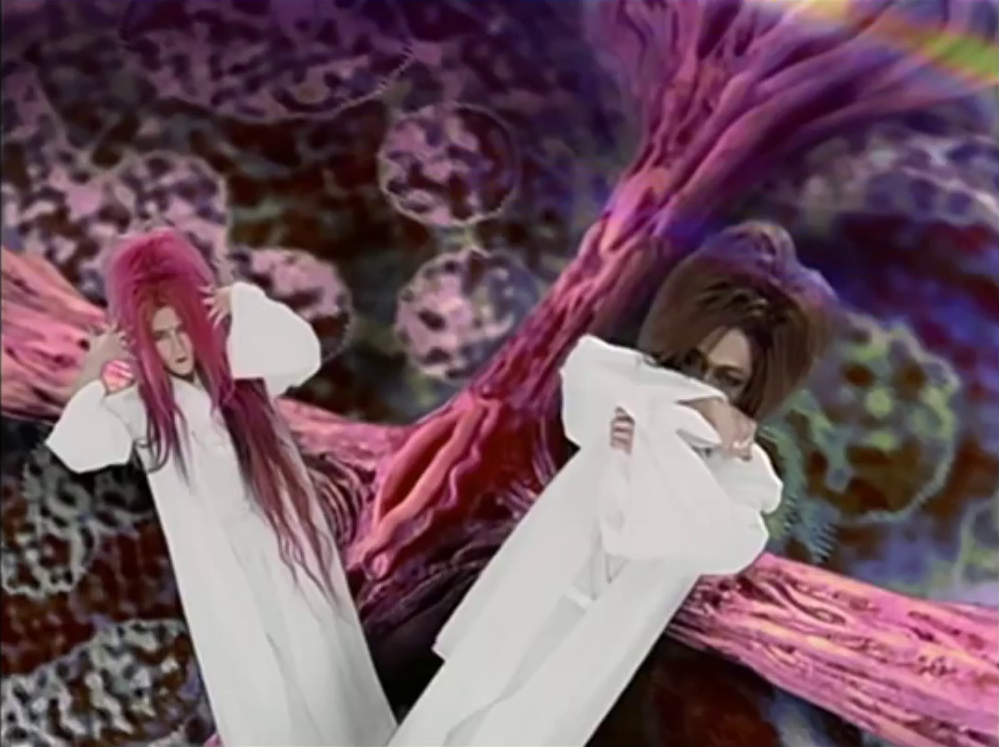
“Everything is wrong in this place. I wonder what will become of us?”

Seth et Holth is a 45-minute film conceptualised by Hide, the guitarist of the band X Japan. Released in the early ‘90s around the band’s commercial peak, It’s one of the most bizarre films involving a musician that I’ve ever come across. I’m perplexed just by the mere existence of it. It’s a trippy, gothic nightmare, fueled entirely by the power of early 90’s video editing software and an ungodly amount of hair dye. I’m by no means an expert when it comes to the glam world of visual kei however I’ve always appreciated the artistry that goes into the band’s wild aesthetics and on-stage antics. X Japan were probably one of the first bands I remember becoming enamoured with when I started getting into Japanese music in my late teens. Their fiery, melodic brand of speed metal endeared itself to me and I quickly found myself obsessed with anything and everything they were involved with.

For the production of Seth et Holth, Hide decided to enlist the help of his friend Tusk Itaya to co-star alongside him. During the ‘90s, Tusk had built his reputation as the frontman for Zi:Kill, a post-punk influenced visual kei group more in the vein of Buck-Tick or early L’Arc-en-Ciel than X Japan. Tusk’s influence over the production can be felt intensely in the visuals and tone, morphing Seth et Holth into darkness, both thematically and musically. X Japan were arguably at the height of their popularity circa 1993, so it’s not surprising Hide had the clout available to get a project like this made. Director Tetsuya Kameyama already had a working relationship with Hide, having photographed X Japan’s Art of Life EP earlier that year. Hide also co-wrote the film with Hideaki Utsumi, a writer and editor most famous for his work on Fool’s Mate magazine, one of the premier visual kei publications of the genre’s heyday.
Seth et Holth (1993)
The plot is as follows: Seth and Holth are two angels living in the realm of Athum, unaware of any other world outside. They spend most, if not all of their time, tenderly caressing and embracing each other. One fateful day, Holth starts to ask Athum questions about the outside world and what exists beyond their plane of existence. Athum then banishes the two to Earth, landing in, you guessed it, the middle of Tokyo.
Overwhelmed by human existence, the two find themselves going insane, terrorising the human populace. After a series of events, the pair are murdered by the humans and find themselves back in Athum’s realm. However Seth and Holth find themselves forever changed by their experiences, unable to go back to the peaceful existence they once had. That’s the gist of it anyway, the actual film itself is pretty hard to follow at the best of times.

The most jarring and most initial aspect of Seth et Holth is the extremely dated early ‘90s visual effects. All of the scenes in Athum’s realm look like a bad acid trip crossed with a Windows 95 screensaver, while Seth and Holth’s costumes look like they came straight off the Hot Topic clearance rack. My stand out visual in is the entrance god ‘Athum’, represented as this incredibly vaginal looking eye puppet. He wouldn’t look out of place in something like Keita Amemiya’s Zeiram (1991) or any number of schlocky 80’s body horror movies.
Aside from an accompanying soundtrack recorded by Hide and Tusk themselves, there was no real tie-in material to speak of. The score is a bit of a mixed bag. There’s no shortage of drum machines, industrial clanging and some music boxes thrown in for a bit of variety. The track ‘Eyes’, an industrial metal song plays during a scene where the camera continuously zooms into Seth and Holth’s, well, eyes, was jarringly reminiscent of Ministry— or if Ministry were doing the background music for a Shin Megami Tensei game. I’m a sucker for anything with orchestral stabs and MIDI guitars, and thankfully Hide and Tusk provide this soundtrack plenty of both.
While most vanity projects are meant to promote an artist’s latest release, such as the Pet Shop Boys It Couldn’t Happen Here (1987) or Michael Jackson’s Moonwalker (1988), Seth et Holth is unique in that it wasn’t intended to promote any actual albums by the respective artists.

There’s not much in the way of spoken dialogue, with the story mainly being told through subtitled narration. The plot, secondary to the visuals, is drenched in interpretations of Christian themes. The imagery here is very occult, with excesses of burning crosses, bloodstained churches and stained glass windows. The entirety of the film is essentially a grabbag of randomised names and imagery from both Christianity and Egyptian mythology.
The film’s most infamous scene features Seth licking Holth’s eyeball, which certainly makes for one hell of an image. If you’re someone who has ommatophobia, you might want to fast forward that part. Hide and Tusk can be seen running around Tokyo in full makeup with bystanders gawking at them. I’m assuming they had a permit for most of the filming, but it’s fun to imagine the bewildered look of a hapless salaryman on his way to work passing by two fully-grown men in makeup with black cloaks and exquisite haircuts.

To say Seth et Holth is extremely homoerotic is cutting it lightly. I’m not kidding when I say most of this movie is just Hide and Tusk making out sloppy style. Like, it happens all the time. Sometimes you’ve just gotta let your inner fujo out and enjoy the ride.
There’s a very chūnibyō feel to the whole production, as if Hide had this idea cooking away since his high school days. Holth’s gigantic eyepatch certainly brings to mind the kind of character design an edgelord teenager would find appealing. That’s honestly why I love Seth et Holth so much, how creative it is. If you’ve ever seen Slava Tsukerman’s Liquid Sky (1982), it almost feels like a 90’s version of that. Incredibly stylish and surreal, yet utterly mesmerising at the same time.

As I said before, the plot is admittedly hard to follow even with the constant narration. The erratic editing is enough to give you a headache at points, in addition to being extremely 90’s. There’s one sequence that’s just a static shot of the duo walking down the staircase of a church while various dissolve transitions are overlaid that goes on for nearly 5 minutes. The angle used for the shot combined with the occult imagery gives me some real “PS1 survival horror game” vibes. I have to admit, I feel Hide was a much better musician than he was a screenwriter. The atmosphere in Seth et Holth is honestly the best aspect of the production, there’s something ever so slightly off about it in the best way possible.

Seth et Holth was first released on VHS and Laserdisc in September 1993, just a month after X Japan’s Art of Life EP hit store shelves. I can’t imagine the furor from moral guardians this would’ve received if it had been released stateside. If they thought Pokémon was satanic, I couldn’t imagine what this would have done to their fragile psyches. From a creative standpoint, I find Seth et Holth. It’s like if two goth teens’ student film was given a budget equivalent to your average Kamen Rider episode and the two went absolutely nuts in the editing room. If nothing else, the imagery is extremely vibrant and captivating. While the movie has been out of print for years, it’s freely available online in various forms if you’re curious to give it a watch. Just make sure to bring some eye drops beforehand.

Leave a Reply