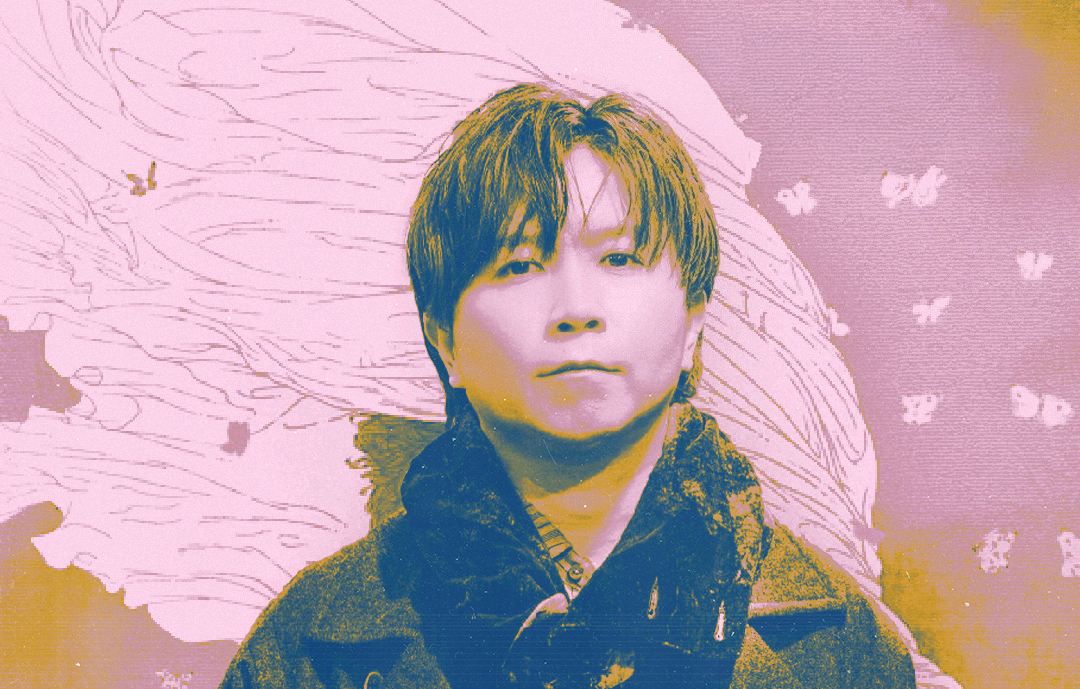
Yoshimasa Terui— the powerhouse for acts such as: Haisuinonasa, Sora Tob Sakana, Siraph, and mastermind behind the official soundtracks for Jujutsu Kaisen Season 2 and 3, Mobile Suit Gundam GQuuuuuuX, the opening for Houseki no Kuni (Land of the Lustrous) speaks to JP ALT about his latest release. In light of Siraph’s new single ‘Sugar Pack’ and the band’s 10 year anniversary, we sat down with the man himself to get his current views on Siraph, his composing career, promising artists, future projects and much more!

Interview
JP ALT: Starting off with Siraph’s newest single ‘Sugar Pack’. The song sounds very sweet and mellow in its composition, your guitar playing and Ghost Camp EP see a very notable change from Siraph’s previous releases which are more complex and abstract. Are ‘Sugar Pack’ and Ghost Camp the general directions that Siraph will be taking from now on?

Yoshimasa Terui: Yes, in Siraph up until now, myself and the keyboard player Masayuki Hasuo used to write songs about half and half. From now on, it’s been decided Hasuo-Kun will be the main one composing and creating the songs. ‘Sugar Pack’ feels like the first song since it was decided that he would take the lead. I don’t know the details of what intentions he had when making it either, but I do feel it’s somewhat the first step into a new form for Siraph.
JP ALT: In your other projects, you are usually the primary composer, but in Siraph, as you mentioned, you share those duties with Masayuki Hasuo. Even so, fans can easily recognize your signature style—not just in your guitar work, but in the synth and drum arrangements too. Is this sound a reflection of current musical trends, or do you and Hasuo simply share very similar tastes?

YT: That’s probably not so much incorporating current trends, but rather that mine and Hasuo-kun’s musical tastes have been similar from the start, I think. Our generations are close too, so I think the music we were influenced by and listened to was also quite similar. And then, well, there might also be parts where we are influencing each other.
JP ALT: I have noticed with Siraph, Sora Tob Sakana and Haisuinonasa, you have a music video format called (Live Video) in which you record yourselves playing the song in one take. With the rise of virtual concerts, is playing an entire set live on stream or a variation of this format something the band may do in the future?
YT: Yes, within Siraph we are talking about wanting to do streaming live shows again in the future. Concretely, we haven’t decided on doing it on a specific day or at a specific place yet.
JP ALT: What are your opinions on the world of video game concerts? Like Fortnite live events, for example.
YT: Oh. My opinion on that? Well, maybe for game fans, or the younger generation who play games, for them I think there are many who don’t have the experience of going to a live house to listen to a performance. It’s not a real raw live show in the sense that you can convey that kind of atmosphere, or the sense of unity in that space, but I think it’s a meaningful thing in terms of being able to simulate that.
JP ALT: Do you prefer to spend time in the studio producing or is touring and playing live something that you enjoy more?
YT: Originally, I preferred producing. However, recently, the amount of that production work has become very large. Like anime soundtracks and such. Because the volume is just a bit too much, performing live, actually playing in front of an audience…there are many times when I feel that is fun. Right now, I kind of want to reduce the amount of my production work a little bit. Rather than live shows, things with my input. I originally liked production the most, but because there’s too much of it, that part which isn’t production is really fun.
JP ALT: Would you like to listen to more live music to be away from the studio? Which live houses do you recommend for people who listen to your style of music?
YT: For the answer to the first question: if I get more time rather than wanting to increase the number of live shows right now, it’s more about discovering new music in general, or reading books.I also like architecture and art. Coming into contact with those sorts of things, inspiration from things other than music. I want to receive a lot of that.
And, for the second question about recommended live houses. Do you know O-nest in Shibuya?
JP ALT: Yes!
YT: Regarding O-nest, I actually used to work there.
JP ALT: How long ago?
YT: Let’s see…maybe 10 years ago or so. It was when I was doing Haisuinonasa. Or maybe more than 10 years ago. As for O-nest, it’s not so much that I recommend the live house’s sound. It’s their booking sense, the bands performing there are interesting, I would recommend it.
JP ALT: Since you are a book lover, what is your favorite genre of books and who are your favorite authors right now?
YT: There isn’t really a specific genre. For novelists my favorite is probably Kobo Abe and with the same last name Abe, there is a slightly younger Japanese novelist named Kazushige Abe, and I think his work is also interesting. When it comes to Kobo Abe, I especially like The Face of Another and The Wall. As for Kazushige Abe, I like Triangles and The ABC War.
JP ALT: Switching from books to manga, what are your favorite works at the moment?
YT: My Name Is Shingo by Kazuo Umezu and Galaxy Ginza by Kenichiro Nagao are my favorites. In addition, I like Ping Pong by Taio Matsumoto. I like shojo manga as well with Moto Hagio being my favorite, although a bit old. As for the new shojo manga artist, George Asakura.
JP ALT: You mentioned Ping Pong, have you watched the anime?
YT: I have seen it.
JP ALT: I would like to hear your impression of Kensuke Ushio’s work as the music composer for this anime.
YT: I think it’s absolutely wonderful. First of all, matching that techno sound to Ping Pong, the result is that it became a very stylish anime, I think. And on top of that, it also has very emotional parts. I think it’s very good, wonderful.

JP ALT: And what is your composing philosophy?
YT: It depends on whether the music I’m making is for my own band or if it’s soundtrack music, but when I can truly create freely, I don’t want it to just be making music influenced solely by music. I want to take inspiration from various things other than music, whether it be other aspects of life, or things I’ve encountered in my life, taking inspiration from non-musical things and expressing it as music. That’s something I want to value.
For example, let’s say on one side there’s a manga artist and that person studies various other manga. Studying nothing but manga and drawing manga based on the influence received from that. On the other side, suppose there’s another manga artist and that person reads manga too, but going through various experiences (for example going on trips, listening to music, watching movies), they incorporate those into their manga. If there were two manga artists like that, I prefer the second one.
JP ALT: When Siraph decides to explore a musical genre you haven’t played before, what is your approach? How do you familiarise yourselves with these new styles to integrate them so seamlessly? The perfect example that comes to mind is that sudden salsa or boogaloo section just before the guitar solo in ‘Damp Damp’.
YT: First of all, I quite like many different genres of music and often listen to various things. The stuff we do in Siraph is quite, how should I say… just a fraction of the music I like, or rather, it’s narrowed down. What we do in Siraph is not necessarily the music I listen to the most regularly. I try to make songs that fit the band called Siraph, but the music I usually listen to as a listener isn’t really music that sounds like Siraph. As for fusing various genres, I don’t know myself if I’m doing it well, but… Well, the influence naturally comes out. But if, say, a genre that I truly don’t listen to at all usually; If I got an offer asking me to fuse that in, of course I would listen to a lot of songs in that genre. I think I would probably do things like rhythm analysis, tone, and analyzing the chord scales being used.
JP ALT: Math rock and more intricate rock styles are becoming more internationally significant and popular. What are your thoughts on touring internationally or worldwide? Is there something for Western Siraph fans to look out for?
YT: I do want to perform overseas. There are no plans at the moment, but well, whether with Siraph or solo, I’m thinking of doing solo activities in the future. Once that starts, I’d like to perform overseas a lot.
JP ALT: Do you have any countries in mind that you would go to first? Any ideal locations for an international tour? For instance, I know Chile is having a boom right now with Japanese artists debuting in Latin America and a very strong math rock scene.
YT: Siraph’s vocalist Annabel, is half Japanese and Argentinian, so partly because of that among the Siraph members we’ve talked about wanting to play live in Argentina someday, but it’s kind of on the other side of the Earth, you know. So I don’t know if we’ll be able to go to Argentina right off the bat. Personally, I have quite a strong desire to visit large cities. For example, New York, or maybe London. Experiencing the cities of the world, in that sense too, I’d like to go perform live there.
JP ALT: And what do you think are some difficulties of touring outside of Japan?
YT: With a band, I think there are of course financial issues. Because there are many people, things like accommodation and travel. The band is going into the red, maybe. Other than that, it would be the language, of course. For example, among the Siraph members, there aren’t people who are that good at English. Well, recently with various translation software and such, I think somehow, we could maybe manage, but still, I do worry about whether we can have solid casual communication to that extent.
JP ALT: My favorite piece of work, both listening to and playing on guitar, is ‘Logos’ by Haisuinonasa. It is such a unique track where every member seems to be doing their own complex thing, leaving Ai Kamano to keep the tempo for the band with her keyboard. What was the creative process like for that arrangement?
YT: First of all, thank you for listening to ‘Logos’. This might be a bit surprising but the guitar phrase in ‘Logos’ is a bit of an antithesis to over-complicated math rock phrases, or phrases that have become too difficult—guitar phrases that just get more and more detailed and technical. The guitar phrase in ‘Logos’ is flashy, but it’s actually quite simple. Like, everyone is making things super difficult, getting increasingly complex, but I had the idea that even without doing that, you could create a similar effect. Like the listening experience, the sensation, I thought it could be made to sound complex, or rather, like it has thickness or depth. It feels like I was throwing a bit of a question towards things that are too complex.
JP ALT: What is the hardest song you have composed or played?
YT: I’m not sure if “difficult” is the right word, but to give you an idea, the pieces I composed while focusing more deeply than ever before—to really grasp the vision—would probably be ‘Animal’s Body’ and ‘Transformation’ from Haisuinonasa.
As for the difficulty of performing them, I don’t think there are many pieces that are particularly complex from a technical standpoint, but the first one that comes to mind—one that’s fast-paced, easy to follow, and packed with notes—is ‘No Hesitation’ from the Jujutsu Kaisen OST.
Setting aside those technical aspects, expressing the feeling that a piece demands is difficult no matter which song it is.
JP ALT: To wrap up the interview by looking toward the future, your work has inspired so many listeners and fellow musicians. I am curious, what inspires you about the newer generation of artists right now? Are there any specific up-and-coming names you predict will make waves or bring something completely new to the scene?
YT: First, in relatively recent music some I quite like and listen to are AG Cook and Maddie Ashman. As for Japanese artists, I enjoy listening to LΛMPLIGHT and a band called Hikari Bunkai. Regarding young artists who might do something in the future, speaking of Japan, well you might know them, and rather than the future they are presently very active: Hakushi Hasegawa, Ohzora Kimishima, Souki Urakami.
Be sure to check out Siraph’s newest single: Sugar Pack. Bookmark japanalternative.net and follow us on our social media for upcoming articles on Yoshimasa Terui and other legendary, up-and-coming, and underground artists!


Leave a Reply